

Leadership in Practice

Practical advice, strategies and insights to help care sector leaders attract, recruit, retain and develop exceptional teams. Our guidance covers everything from writing job adverts that attract the right people and identifying interview red flags to understanding the cost of a toxic team member, with a range of resources to help you build stronger, more effective workforces.




Recruitment is one of the most important decisions a healthcare organisation makes. The right employee can strengthen a team, improve outcomes for the people they support and contribute to a positive workplace culture. The wrong hire can affect colleagues, service users and the quality of care.
Interviews are an opportunity to look beyond qualifications and experience. They help employers understand how a candidate communicates, behaves under pressure and whether they share the values needed to work in health and social care.
While no candidate is perfect, recognising potential red flags can help employers make safer and more informed recruitment decisions.
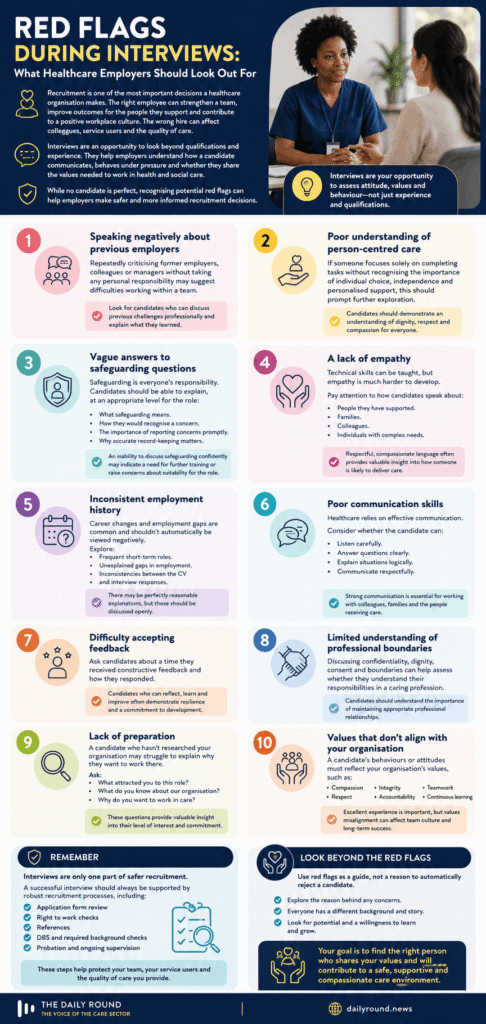
Candidates may have had genuine reasons for leaving previous roles. However, repeatedly criticising former employers, colleagues or managers without taking any personal responsibility may suggest difficulties working within a team.
Look for candidates who can discuss previous challenges professionally and explain what they learned from the experience.
Whether recruiting for care assistants, nurses, support workers or managers, candidates should demonstrate an understanding of treating people with dignity, respect and compassion.
If someone focuses solely on completing tasks without recognising the importance of individual choice, independence and personalised support, this should prompt further exploration.
Safeguarding is everyone’s responsibility.
Candidates should be able to explain, at an appropriate level for the role:
An inability to discuss safeguarding confidently may indicate a need for further training or raise concerns about suitability for the role.
Technical skills can be taught, but empathy is much harder to develop.
Pay attention to how candidates speak about:
Respectful, compassionate language often provides valuable insight into how someone is likely to deliver care.
Career changes, temporary contracts and employment gaps are common and should not automatically be viewed negatively.
However, it is important to explore:
There may be perfectly reasonable explanations, but these should be discussed openly.
Healthcare relies on effective communication.
During the interview, consider whether the candidate can:
Strong communication is essential for working with colleagues, families and the people receiving care.
Healthcare professionals learn throughout their careers.
Ask candidates about a time they received constructive feedback and how they responded.
Candidates who can reflect, learn and improve often demonstrate resilience and a commitment to professional development.
Candidates should understand the importance of maintaining appropriate professional relationships with the people they support.
Discussing confidentiality, dignity, consent and boundaries can help assess whether they understand the responsibilities of working in a caring profession.
A candidate who has not researched your organisation may struggle to explain why they want to work there. Preparation demonstrates genuine interest and motivation.
Simple questions such as:
can provide valuable insight into their level of commitment.
Perhaps the biggest red flag is when a candidate’s behaviours or attitudes do not reflect your organisation’s values. Healthcare organisations often prioritise qualities such as:
A candidate may have excellent experience, but if their values do not align with those of the organisation, they may not be the right long-term fit. Understanding the cost of a toxic team member can also help employers recognise why cultural fit and positive behaviours matter when making recruitment decisions.
A successful interview should always be supported by robust recruitment processes, including:
Safer recruitment helps protect both organisations and the people who rely on their services.
Every candidate will be nervous, and one uncertain answer should not determine the outcome of an interview.
Rather than looking for perfection, interviewers should look for evidence of the behaviours, values and attitudes that are essential in health and social care. A thoughtful interview process, combined with robust recruitment checks, helps organisations build compassionate, capable teams that deliver safe, high-quality care.
A well-structured approach to organising your recruitment process can also help employers create consistency from the initial application through to the final appointment.
Recruiting for health and social care is about much more than filling vacancies. Every appointment has the potential to influence the quality of care, team morale and organisational culture. By focusing on values as well as competence, employers can make recruitment decisions that benefit both their workforce and the people they support.
Employers looking for further guidance on developing strong, effective teams can explore Building Great Teams for practical insights and resources.
Join organisations across health and social care that are investing in happier, healthier workplaces with the Daily Round Wellbeing Employer programme.
Download our Employer Wellbeing Brochure to discover what’s included, or become a Daily Round Wellbeing Employer today.
Posted by:
M Ramalani
Editorial Assistant – The Daily Round
Busy day? We’ve got you covered. Get FREE daily news, practical insights, opportunities and wellbeing content, carefully curated for busy health and social care professionals. Just enter your details below to get The Daily Briefing delivered straight to your inbox.
 newsdesk@dailyround.news