

Leadership in Practice

Practical advice, strategies and insights to help care sector leaders attract, recruit, retain and develop exceptional teams. Our guidance covers everything from writing job adverts that attract the right people and identifying interview red flags to understanding the cost of a toxic team member, with a range of resources to help you build stronger, more effective workforces.




When people feel safe to speak up, ask questions and admit mistakes, everyone benefits.
The phrase psychological safety has become one of the most talked-about leadership concepts in recent years, but it’s often misunderstood. It doesn’t mean lowering standards or avoiding difficult conversations. It doesn’t mean everyone agrees with each other. Instead, psychological safety is about creating an environment where people feel able to contribute without fear of embarrassment, blame or unfair judgement.
In healthcare and social care, where teamwork and communication directly affect people’s lives, that matters more than ever.
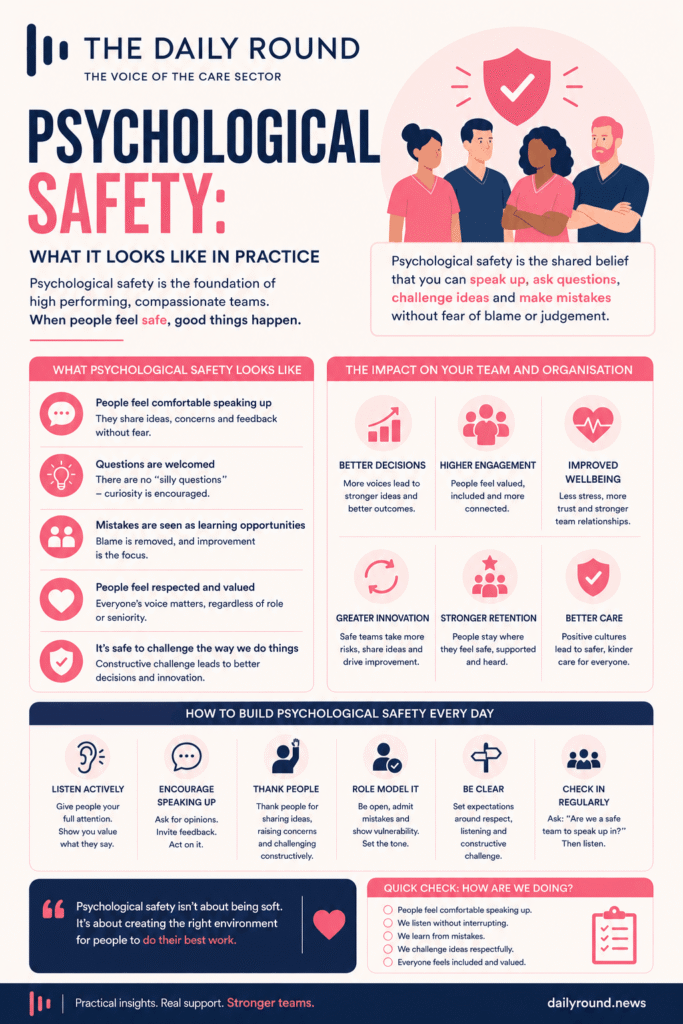
The term was popularised by Harvard Business School professor Amy Edmondson, who describes psychological safety as a shared belief that a team is safe for interpersonal risk-taking. In simple terms, it’s knowing you can say:
“I’m not sure.”
“I think we’ve made a mistake.”
“Can I ask a question?”
“I have an idea.”
…without worrying that you’ll be criticised, ignored or ridiculed.
When people feel psychologically safe, they contribute more, learn faster and work together more effectively.
Psychological safety isn’t something written in a policy. It’s something people experience every day. In psychologically safe teams:
These behaviours build trust over time.
Healthcare and social care professionals make hundreds of decisions every day. If someone notices a potential medication error, a safeguarding concern or a clinical risk, they must feel confident speaking up immediately.
A workplace where staff are afraid to challenge decisions or admit uncertainty creates unnecessary risk. Conversely, organisations with psychologically safe cultures often see stronger teamwork, greater innovation and improved patient outcomes because concerns are identified earlier and addressed openly.
Psychological safety isn’t simply a wellbeing initiative, it is an important contributor to safer care.
Culture is shaped by leadership. Managers don’t need to have all the answers, but they do need to create the conditions where people feel heard. Simple behaviours can make a significant difference.
These small moments send a powerful message: “It’s safe to speak here.”
Sometimes the warning signs are subtle. You might notice:
Silence is not always a sign that everything is going well. Sometimes it’s a sign that people no longer believe their voice matters.
Creating a psychologically safe culture doesn’t require a large budget. It requires consistency.
Try asking questions such as:
When someone raises a concern, resist the urge to become defensive. Instead, thank them. People quickly learn whether speaking up is genuinely welcomed or simply encouraged in theory.
Psychological safety isn’t created through a single workshop or annual training session. It’s built one conversation at a time. Every interaction between a leader and their team either strengthens trust or weakens it.
The organisations with the strongest cultures are rarely those with the most policies. They’re the ones where people know their voice matters.
Healthcare has never depended on people having all the answers. It has always depended on people being willing to ask the right questions.
The strongest teams aren’t those that never make mistakes, they’re the ones where people feel confident enough to admit them, learn from them and improve together. If your staff are comfortable saying, “I think we’ve got this wrong,” you’ve already built something incredibly valuable. Because psychological safety isn’t about making work easier. It’s about making work safer, for colleagues, patients, residents and everyone who depends on great teamwork.
Join organisations across health and social care that are investing in happier, healthier workplaces with the Daily Round Wellbeing Employer programme.
Download our Employer Wellbeing Brochure to discover what’s included, or become a Daily Round Wellbeing Employer today.
Posted by:
Mehala
Editorial Assistant – The Daily Round
Busy day? We’ve got you covered. Get FREE daily news, practical insights, opportunities and wellbeing content, carefully curated for busy health and social care professionals. Just enter your details below to get The Daily Briefing delivered straight to your inbox.
 newsdesk@dailyround.news