

Leadership in Practice

Book recommendations, reviews and key takeaways to inspire leadership, personal growth, business success and professional development across the care sector. Discover titles such as Atomic Habits by James Clear, which examines how small changes can lead to lasting improvements, and Surrounded by Idiots by Thomas Erikson, which looks at different communication styles and how to better understand the people around you.
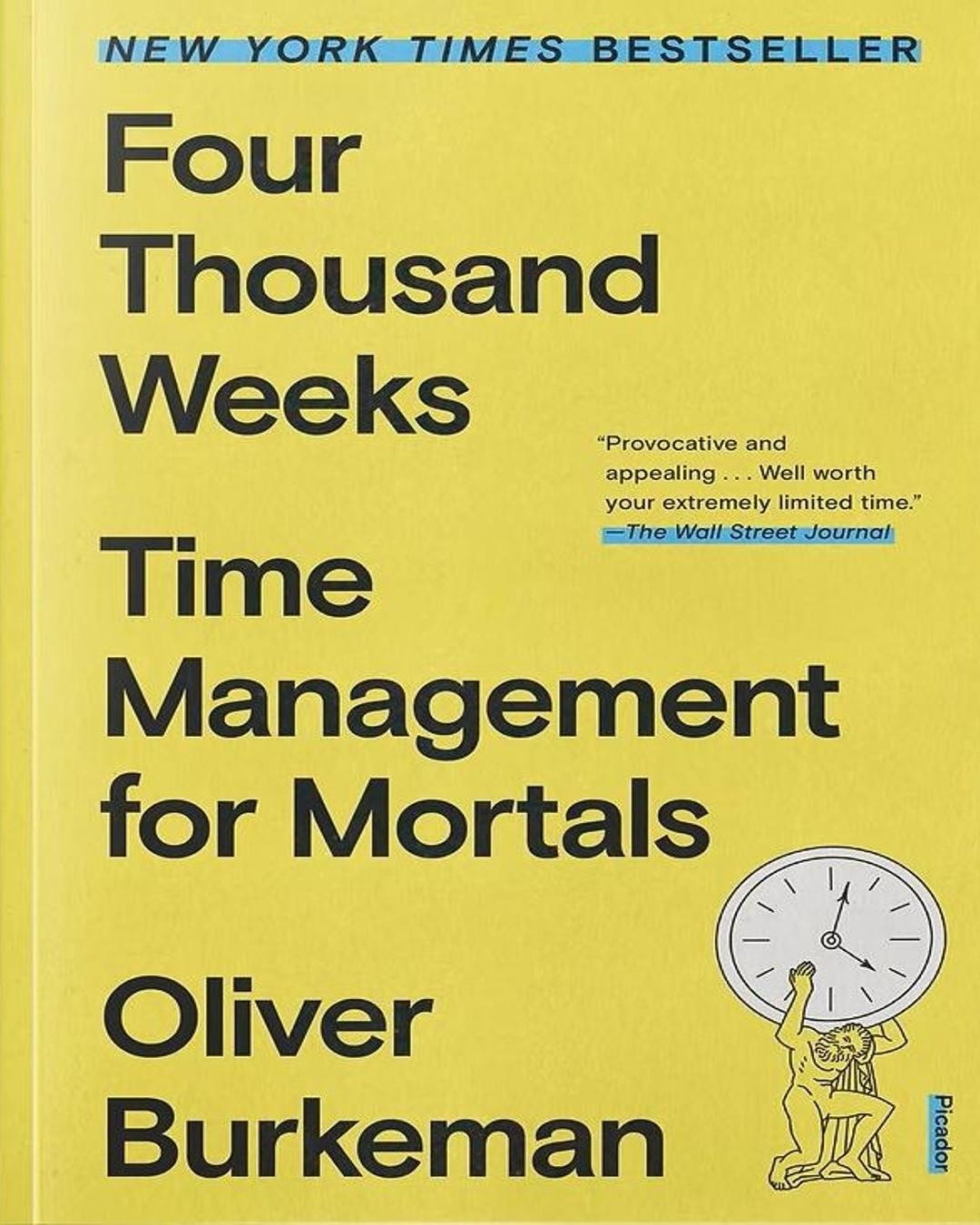



When you think about how many weeks you’re probably going to live, it puts into perspective just how important every week of your life actually is. Well, that’s what I thought when I read Four Thousand Weeks anyway.
The idea behind the title is surprisingly simple. If you live to around 80, your life amounts to roughly 4,000 weeks. Four thousand.
When you see your entire life expressed as a number like that, it suddenly doesn’t sound very long.
Four Thousand Weeks: Time Management for Mortals by Oliver Burkeman isn’t your typical time-management book. It isn’t about squeezing another task into your day, getting up at 5am or finding the perfect productivity system that will finally allow you to clear your to-do list.
In fact, Burkeman’s argument is almost the opposite. You are never going to get everything done. There will always be another email to answer, another task that could be completed, another meeting, another target and another thing demanding your attention.
Once you accept that, the question changes from “How can I fit everything in?” to something much more important – What actually deserves my time?
I think this is particularly relevant for leaders because there is always something else you could be doing.
When you’re responsible for a business, a service or a team, work can quite easily expand to fill every available space in your life. Finish one problem and another appears. Clear your inbox and, somehow, there are another 20 emails waiting for you. And being busy can start to feel like being successful.
But Four Thousand Weeks makes you think about whether that’s actually true. If our time really is as limited as Burkeman reminds us it is, then good time management can’t simply mean doing more. Sometimes it has to mean deciding what isn’t worth doing at all.
For leaders, I think there’s a valuable lesson in that. Not every meeting needs to happen. Not every email requires an immediate response. Not every problem needs your personal involvement and not every opportunity deserves a yes.
The things you choose to give your time to matter precisely because you cannot give your time to everything. That applies to leadership, but it also applies outside work.
How many weeks do we spend saying we’ll take the holiday next year, spend more time with our family when work calms down, read the book when we’re less busy or finally do that thing we’ve wanted to do when we’ve got more time?
The uncomfortable truth is that there isn’t an unlimited supply of “later”. That’s probably the biggest thing I took away from this book. It didn’t make me want to become better at cramming more into my diary. It made me think more carefully about what I was putting into it in the first place.
I gave Four Thousand Weeks ★★★★☆ – 4 out of 5 stars.
It’s thoughtful, different and certainly made me look at time from another perspective. If you’re looking for a traditional productivity book full of hacks for getting more done, this probably isn’t it. But if you’re a busy leader who constantly feels as though there aren’t enough hours in the day, it’s worth reading.
After all, you’ve only got so many weeks. They’re worth your time too.
Jill NeweyEditor-in-Chief
Posted by:
M Ramalani
Editorial Assistant – The Daily Round
Busy day? We’ve got you covered. Get FREE daily news, practical insights, opportunities and wellbeing content, carefully curated for busy health and social care professionals. Just enter your details below to get The Daily Briefing delivered straight to your inbox.
 newsdesk@dailyround.news