

Leadership in Practice

Practical guidance, tools, and best practice to help care sector leaders manage people, develop staff, navigate compliance, and lead with confidence every day.



Employee wellbeing should be discussed in the boardroom just as often as finance, quality and performance.
For many organisations, staff wellbeing is recognised as important, but it’s not always measured, monitored or discussed strategically. Boards routinely review financial reports, occupancy levels, recruitment figures and regulatory performance. Yet the wellbeing of the workforce, one of an organisation’s greatest assets, is often only considered when problems begin to emerge.
High sickness absence, rising turnover, low morale and recruitment challenges rarely happen overnight. They are often the result of issues that have gone unnoticed for too long. The most effective boards don’t wait for a crisis. They ask the right questions before one develops.
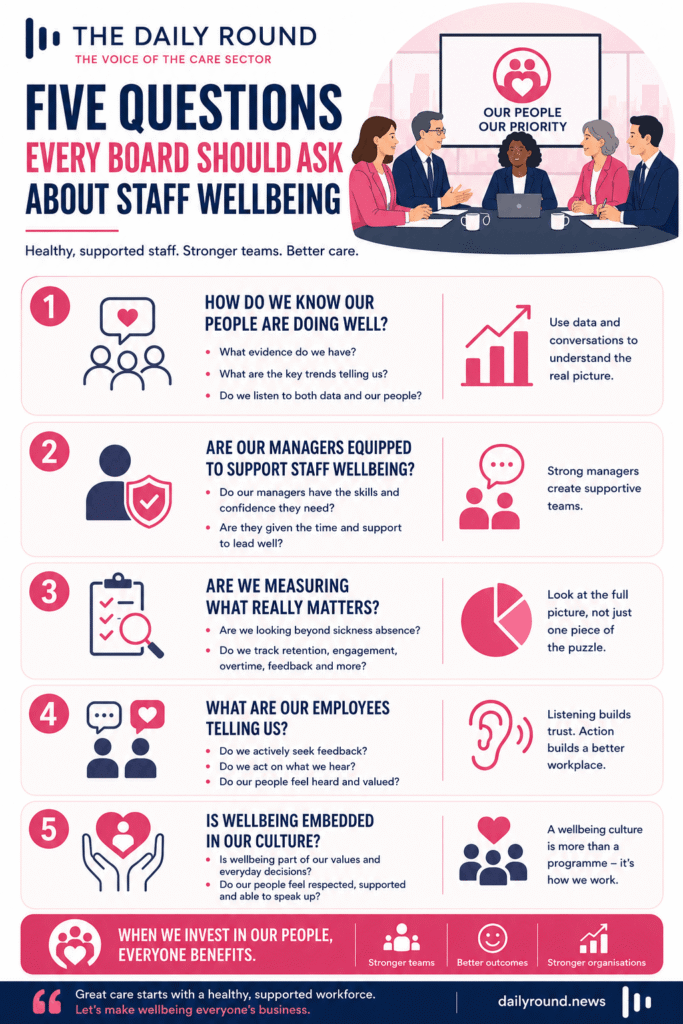
Good intentions aren’t enough. Boards should look beyond assumptions and ask what evidence exists to demonstrate employee wellbeing.
This might include:
Data provides valuable insight, but it should always be supported by conversations with the workforce. Numbers tell part of the story. People tell the rest.
Managers have one of the biggest influences on an employee’s day-to-day experience. Even the strongest wellbeing strategy will struggle if leaders don’t feel confident having supportive conversations, recognising early signs of stress or creating psychologically safe teams.
Boards should ask whether managers receive the training, time and support needed to lead effectively. Supporting managers is one of the best ways to support the wider workforce.
Many organisations focus heavily on absence. But wellbeing is about far more than who is off sick. Boards should also consider:
Looking at these indicators together provides a much more complete picture of organisational health.
Employees often identify problems long before they appear in performance reports. The question is whether organisations are genuinely listening. Staff should have regular opportunities to share ideas, raise concerns and offer feedback.
Just as importantly, they need to see that feedback leads to action. Listening without responding quickly damages trust.
A wellbeing programme is valuable. A wellbeing culture is transformational.
Boards should ask whether wellbeing is reflected in everyday leadership, decision-making and organisational values, not just annual campaigns or awareness days.
If the answer to those questions is yes, wellbeing is becoming part of the organisation’s culture rather than simply another initiative.
Investing in staff wellbeing isn’t simply about supporting employees, it also strengthens organisational performance. Healthier, happier teams are more engaged, more productive and more likely to remain with their employer.
Strong wellbeing strategies can contribute to improved recruitment, better retention, reduced sickness absence and stronger workplace culture. When organisations invest in their people, everyone benefits, including the people they care for.
The best boards don’t just ask these questions once a year. They make workforce wellbeing a standing agenda item, reviewing progress alongside quality, finance and operational performance. When leaders consistently ask the right questions, they create organisations where wellbeing becomes everyone’s responsibility, not just HR’s.
Boards are responsible for setting the direction of an organisation. That responsibility doesn’t end with financial sustainability or regulatory compliance. It also includes creating an environment where people can do their best work.
Every decision made in the boardroom eventually reaches the frontline. The question is whether those decisions make work better for the people delivering care. Because when your workforce is thriving, your organisation is in a far stronger position to thrive too.
Join organisations across health and social care that are investing in happier, healthier workplaces with the Daily Round Wellbeing Employer programme.
Download our Employer Wellbeing Brochure to discover what’s included, or become a Daily Round Wellbeing Employer today.
Posted by:
Mehala
Editorial Assistant – The Daily Round
Busy day? We’ve got you covered. Get FREE daily news, practical insights, opportunities and wellbeing content, carefully curated for busy health and social care professionals. Just enter your details below to get The Daily Briefing delivered straight to your inbox.
 newsdesk@dailyround.news