

Leadership in Practice

Practical advice, strategies and insights to help care sector leaders attract, recruit, retain and develop exceptional teams. Our guidance covers everything from writing job adverts that attract the right people and identifying interview red flags to understanding the cost of a toxic team member, with a range of resources to help you build stronger, more effective workforces.




Strong leadership does not happen by chance. It develops over time through experience, support, learning and the opportunity to grow.
Across health and social care, organisations face increasing challenges, including workforce shortages, rising demand and changing regulatory expectations. Developing future leaders is essential to ensuring services remain resilient, compassionate and focused on delivering high-quality care.
Leadership succession should not begin when a manager resigns, it should be part of everyday organisational planning.
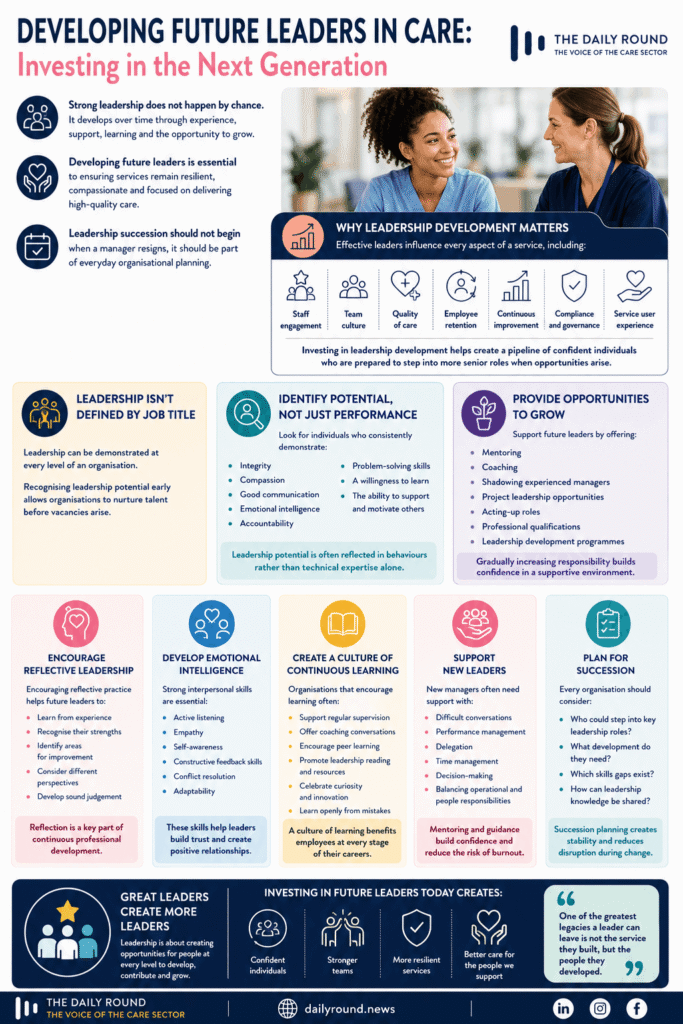
Effective leaders influence every aspect of a service, including:
Investing in leadership development helps create a pipeline of confident individuals who are prepared to step into more senior roles when opportunities arise.
Leadership can be demonstrated at every level of an organisation. A senior care worker who supports colleagues, a nurse who mentors new staff or a team leader who encourages improvement may all demonstrate leadership behaviours without holding senior management positions.
Recognising leadership potential early allows organisations to nurture talent before vacancies arise.
Being an excellent employee does not automatically mean someone is ready to lead others. When identifying future leaders, look for individuals who consistently demonstrate:
Leadership potential is often reflected in behaviours rather than technical expertise alone.
Leadership skills develop through practical experience as well as formal learning. Organisations can support future leaders by offering:
Gradually increasing responsibility allows employees to build confidence in a supportive environment.
Healthcare leaders make decisions that affect both employees and the people receiving care. Encouraging reflective practice helps future leaders to:
Reflection is an important part of continuous professional development.
Technical knowledge is important, but leadership also requires strong interpersonal skills. Future leaders should be encouraged to develop:
These skills help leaders build trust and create positive working relationships.
Leadership development should not be limited to occasional training courses. Organisations that encourage continuous learning often:
A culture of learning benefits employees at every stage of their careers.
Promotion can be exciting, but it can also feel overwhelming. New managers often need support with:
Providing mentoring and regular guidance during the transition into leadership can improve confidence and reduce the risk of burnout.
Every organisation should consider:
Succession planning helps organisations remain stable during periods of change and reduces disruption when senior employees leave.
The most successful healthcare organisations understand that leadership is not about a few individuals at the top, it is about creating opportunities for people at every level to develop, contribute and grow.
By investing in future leaders today, organisations strengthen their workforce for tomorrow. Employees who feel supported to develop are more engaged, more likely to remain with the organisation and better equipped to inspire others. Ultimately, developing leaders is not just about preparing people for management roles, it is about building compassionate, confident teams that deliver outstanding care.
One of the greatest legacies a leader can leave is not the service they built, but the people they developed. Organisations that consistently identify potential, nurture talent and invest in leadership at every level are better prepared for the future and better placed to deliver safe, high-quality, person-centred care.
Join organisations across health and social care that are investing in happier, healthier workplaces with the Daily Round Wellbeing Employer programme.
Download our Employer Wellbeing Brochure to discover what’s included, or become a Daily Round Wellbeing Employer today.
Posted by:
M Ramalani
Editorial Assistant – The Daily Round
Busy day? We’ve got you covered. Get FREE daily news, practical insights, opportunities and wellbeing content, carefully curated for busy health and social care professionals. Just enter your details below to get The Daily Briefing delivered straight to your inbox.
 newsdesk@dailyround.news