

Leadership in Practice

Practical advice, strategies and insights to help care sector leaders attract, recruit, retain and develop exceptional teams. Our guidance covers everything from writing job adverts that attract the right people and identifying interview red flags to understanding the cost of a toxic team member, with a range of resources to help you build stronger, more effective workforces.


Strong leadership is one of the biggest influences on the quality of care an organisation provides. Yet many people step into management roles believing they simply need to tell people what to do.
In reality, great healthcare leaders know when to manage and when to coach.
Both approaches are valuable, but they serve different purposes. Understanding when to use each can improve staff confidence, strengthen team performance and ultimately lead to better outcomes for the people receiving care.
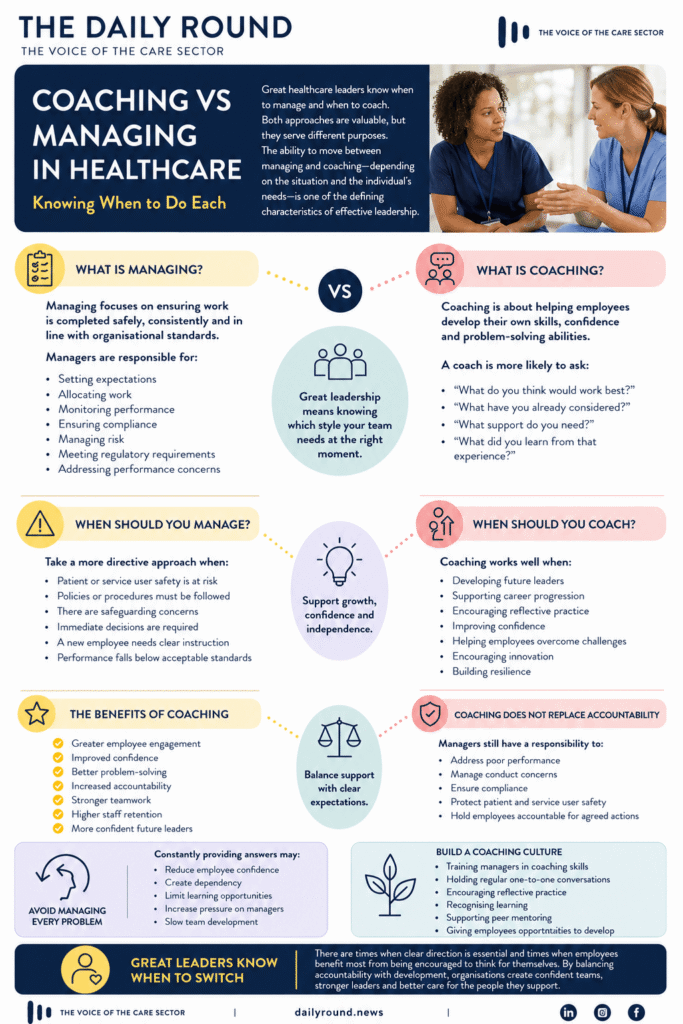
Managing focuses on ensuring work is completed safely, consistently and in line with organisational standards. Managers are responsible for:
In healthcare, effective management helps ensure services remain safe, organised and compliant with professional and regulatory standards.
Coaching is about helping employees develop their own skills, confidence and problem-solving abilities. Rather than providing all the answers, a coaching approach encourages people to think critically and find solutions themselves.
A coach is more likely to ask:
This approach promotes learning, ownership and continuous improvement.
There are situations where clear direction is essential. Managers should take a more directive approach when:
During these situations, employees need certainty and guidance rather than open-ended discussion.
Coaching is particularly valuable when employees already have the knowledge and capability but need support to develop confidence or solve problems independently.
Coaching works well when:
Rather than creating dependency on managers, coaching helps employees become more confident decision-makers.
Healthcare organisations that encourage coaching often see:
Employees who feel trusted and supported are often more motivated to learn and improve.
It can be tempting for busy managers to solve every issue themselves. However, constantly providing answers may:
Sometimes the most effective leadership response is to ask a thoughtful question rather than immediately provide a solution.
A coaching style should never mean avoiding difficult conversations. Managers still have a responsibility to:
The most effective leaders combine support with clear expectations.
Organisations can encourage coaching by:
When coaching becomes part of everyday leadership, employees are more likely to feel empowered to grow and contribute.
Successful healthcare leaders rarely rely on one leadership style. There are times when clear direction is essential and times when employees benefit most from being encouraged to think for themselves. The ability to move between managing and coaching, depending on the situation and the individual’s needs is one of the defining characteristics of effective leadership.
By balancing accountability with development, organisations create confident teams, stronger leaders and better care for the people they support.
Management keeps organisations safe, compliant and effective. Coaching helps people grow, innovate and reach their potential. The strongest healthcare leaders understand that leadership is not about choosing one approach over the other—it is about knowing which style your team needs at the right moment.
Join organisations across health and social care that are investing in happier, healthier workplaces with the Daily Round Wellbeing Employer programme.
Download our Employer Wellbeing Brochure to discover what’s included, or become a Daily Round Wellbeing Employer today.
Posted by:
M Ramalani
Editorial Assistant – The Daily Round
Busy day? We’ve got you covered. Get FREE daily news, practical insights, opportunities and wellbeing content, carefully curated for busy health and social care professionals. Just enter your details below to get The Daily Briefing delivered straight to your inbox.
 newsdesk@dailyround.news