newsdesk@dailyround.news
UK News

Stay up to date with the latest health and social care news from across the UK. From children’s mental health crisis and new inspection guidance for prison education to women’s mental health after childbirth and employment reforms affecting UK employers, discover the stories and developments shaping the sector.
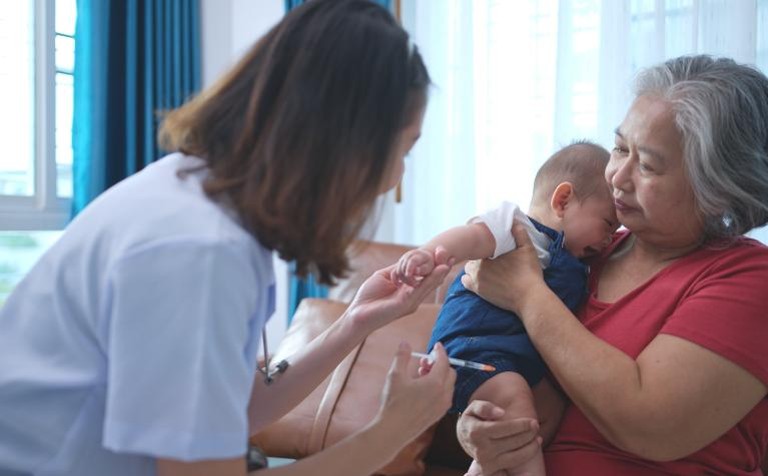
More babies in England are missing routine vaccinations at the recommended age, despite signs that NHS catch-up efforts are helping vaccination rates stabilise by the time children start primary school.
New figures from the UK Health Security Agency show that uptake among children measured at both one and two years old fell for every vaccine during 2025/26. Although coverage among five-year-olds has stopped declining for some key vaccinations, no childhood vaccine measured in the programme currently reaches the World Health Organization’s 95% target.
The distinction between receiving a vaccine eventually and receiving it on time is important. Routine childhood vaccinations are scheduled according to the ages at which children need protection, meaning a child who is subsequently caught up at four or five may have spent months or years without the protection they should already have had.
Among babies measured at 12 months, uptake of the 6-in-1 vaccine fell by 0.9 percentage points in England during the latest year, to 90.8%. The vaccine protects against six serious infections: diphtheria, hepatitis B, Hib, polio, tetanus and whooping cough.
Coverage of other vaccinations due during infancy also declined. Uptake of the pneumococcal vaccine fell by one percentage point, rotavirus vaccination fell by 0.4 percentage points and meningococcal B vaccination fell by 0.5 percentage points among children measured at their first birthday.
The latest provisional figures suggest the challenge has continued into 2026. In May, 84.7% of six-month-old babies had received all three scheduled doses of the 6-in-1 vaccine, 0.8 percentage points lower than a year earlier. Coverage of the second rotavirus dose stood at 86.7%, down 2.1 percentage points compared with May 2025.
There are, however, some encouraging signs. Changes to the meningococcal B vaccination schedule appear to have improved uptake of an earlier second dose, with 89.5% of six-month-olds receiving it in May, 2.6 percentage points higher than a year earlier. The introduction of the combined MMRV vaccine, which added protection against chickenpox to measles, mumps and rubella vaccination from January, has also so far maintained similar uptake to the previous MMR programme.
By the age of five, the longer-term picture is beginning to look more stable. Uptake of two MMR doses among five-year-olds was 83.8% in 2025/26, compared with 83.7% the previous year and 83.9% in 2023/24. Coverage of the 6-in-1 vaccine measured at five was 92.9%, compared with 92.8% and 92.6% respectively during the previous two years.
The pre-school booster, which provides additional protection against diphtheria, tetanus, whooping cough and polio, also recorded a small improvement. Uptake increased from 81.3% to 81.9%, although UKHSA cautioned that it is too early to determine whether this represents the beginning of a sustained upward trend.
UKHSA believes NHS catch-up activity is one factor behind the stabilisation among older children. Additional vaccination clinics, school catch-up opportunities and targeted local outreach have been used to find children who missed vaccinations when they were originally due.
That means the figures tell two slightly different stories. The NHS appears to be having some success finding older children who previously missed vaccinations, but the proportion receiving protection at the ages originally recommended continues to cause concern.
Dr Mary Ramsay, director of immunisation at UKHSA, described the stabilisation as encouraging but warned there remained a considerable distance to go before children were receiving full protection at the appropriate time. She urged parents whose children have missed vaccinations to contact their GP practice, stressing that it is possible to catch up on most routine childhood vaccines.
England has experienced a long-term decline in childhood vaccination coverage, with rates falling across the programme over approximately a decade. That has increased concern about diseases which became uncommon following the introduction of widespread immunisation but can return when population protection falls.
Measles presents a particular challenge because it is exceptionally infectious and requires very high levels of vaccination coverage to prevent sustained transmission. Two doses of a measles-containing vaccine are recommended, yet only 83.8% of five-year-olds had received both doses in the latest annual figures, considerably below the 95% target.
Low uptake is not distributed evenly across England. London continues to record the lowest coverage across all childhood vaccination indicators, while substantial differences can exist between individual local authorities.
The latest monthly data illustrates the scale of those inequalities. In May, coverage of the pre-school booster among five-year-olds ranged from just 52.1% in Westminster to 95.4% in South Tyneside – a difference of more than 43 percentage points. Across NHS commissioning regions, coverage ranged from 69.8% in London to 89.3% in the South West.
Access is one part of the challenge. Families may struggle to attend appointments during working hours, move between areas or miss invitations, while language, deprivation and difficulties navigating healthcare can create additional barriers. Vaccine confidence and misinformation can also affect uptake, meaning improving coverage requires more than simply reminding parents that vaccinations are available.
NHS England has been encouraging GP practices to make vaccination more accessible, including through flexible appointments, additional clinics and proactive contact with families whose children have missed doses. A national childhood vaccination campaign launched in February is also attempting to provide parents with clearer information and make vaccines easier to access.
The stabilisation seen among five-year-olds therefore offers some evidence that children who initially miss vaccinations can be reached. But relying on catch-up programmes is not the same as ensuring children are protected when vaccines are first recommended.
Vaccines offered during infancy are scheduled at those ages because babies can be particularly vulnerable to serious infectious diseases. Improving the headline vaccination rate by the time children reach school is valuable, but the more difficult challenge for the NHS is preventing them from falling behind in the first place.
Posted by:
K Jadon
Editorial Assistant – The Daily Round



Busy day? We’ve got you covered. Get FREE daily news, practical insights, opportunities and wellbeing content, carefully curated for busy health and social care professionals. Just enter your details below to get The Daily Briefing delivered straight to your inbox.
Busy day? We’ve got you covered. Get FREE daily news, practical insights, opportunities and wellbeing content, carefully curated for busy health and social care professionals. Just enter your details below to get The Daily Briefing delivered straight to your inbox.