

Wellbeing for Leaders

Practical advice, strategies, and insights to help leaders across the care sector attract, recruit, retain, and develop exceptional teams.




Technical skills and qualifications are important, but in health and social care, values are often what define exceptional employees. Compassion, dignity, respect and integrity cannot simply be listed on a CV, they are demonstrated through behaviours, decisions and the way people treat others.
A values-based recruitment process helps organisations identify candidates whose attitudes and behaviours align with their culture and the needs of the people they support. When combined with robust safer recruitment practices, it can improve retention, strengthen teams and ultimately lead to better outcomes for service users.
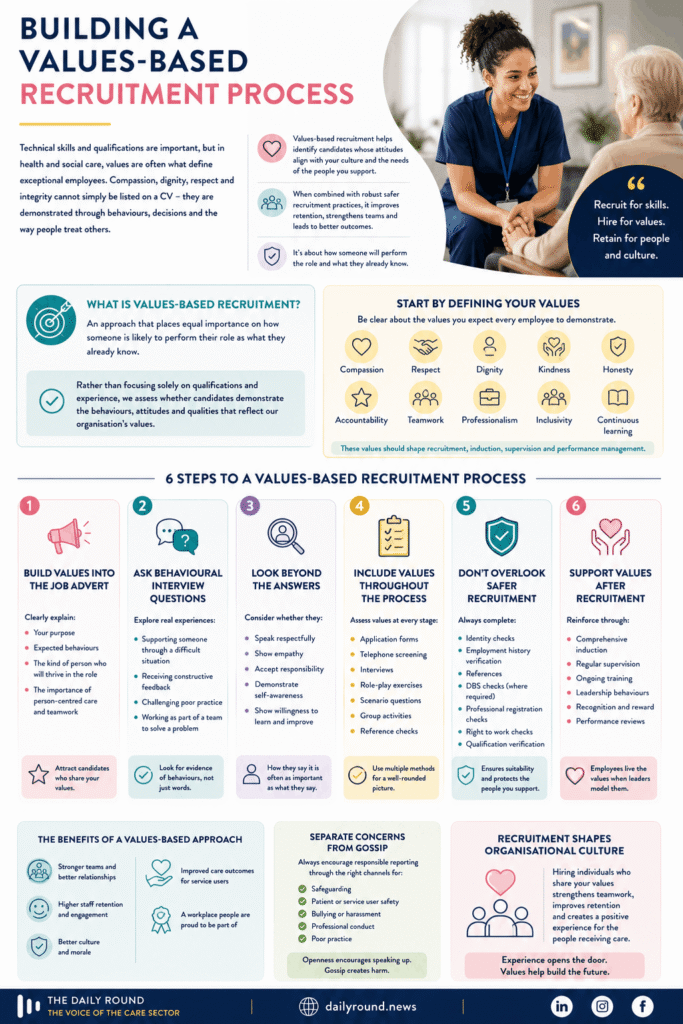
Values-based recruitment is an approach that places equal importance on how someone is likely to perform their role as what they already know. Rather than focusing solely on qualifications and experience, employers assess whether candidates demonstrate the behaviours, attitudes and personal qualities that reflect the organisation’s values.
This approach is widely used across health and social care because the way care is delivered is just as important as the tasks being carried out.
Before recruiting, organisations should be clear about the values they expect every employee to demonstrate.
These may include:
These values should be more than words on a website—they should shape recruitment, induction, supervision and performance management.
The recruitment process starts long before the interview. A job advert should clearly explain:
Candidates who identify with your values are more likely to apply and remain engaged once appointed.
One of the best ways to assess values is to ask candidates about real situations they have experienced.
For example:
These questions encourage candidates to provide evidence of their behaviours rather than simply saying they are compassionate or hardworking.
Pay attention not only to what candidates say, but how they say it. Consider whether they:
These behaviours often provide valuable insight into how someone is likely to work within your organisation.
Values can be assessed at every stage of recruitment, including:
Using multiple assessment methods provides a more rounded picture of each candidate.
Values-based recruitment should complement—not replace—robust safer recruitment procedures. Employers should continue to complete appropriate:
Together, these measures help ensure both suitability and safety.
Recruitment is only the beginning. Organisations should reinforce their values through:
Employees are far more likely to demonstrate organisational values when they see leaders modelling them every day.
Every person you recruit influences the culture of your organisation.
Hiring individuals who share your values can strengthen teamwork, improve staff retention and create a more positive experience for the people receiving care. While experience and qualifications remain important, attitudes, behaviours and compassion are often what distinguish good employees from truly exceptional ones.
Building a values-based recruitment process helps organisations recruit not just people who can do the job, but people who will deliver care with professionalism, empathy and respect.
Skills can often be developed through training, but values influence every interaction an employee has with colleagues, families and the people they support. Organisations that consistently recruit for both competence and character are better placed to build resilient teams, maintain a positive culture and deliver high-quality, person-centred care.
Join organisations across health and social care that are investing in happier, healthier workplaces with the Daily Round Wellbeing Employer programme.
Download our Employer Wellbeing Brochure to discover what’s included, or become a Daily Round Wellbeing Employer today.
Posted by:
M Ramalani
Editorial Assistant – The Daily Round
Busy day? We’ve got you covered. Get FREE daily news, practical insights, opportunities and wellbeing content, carefully curated for busy health and social care professionals. Just enter your details below to get The Daily Briefing delivered straight to your inbox.
 newsdesk@dailyround.news