

Leadership in Practice

Guidance, inspiration, and practical support to help leaders manage wellbeing, build resilience, overcome challenges, and maintain a healthy work-life balance.


When someone asks you to tell them about yourself, how long does it take before you start talking about work?
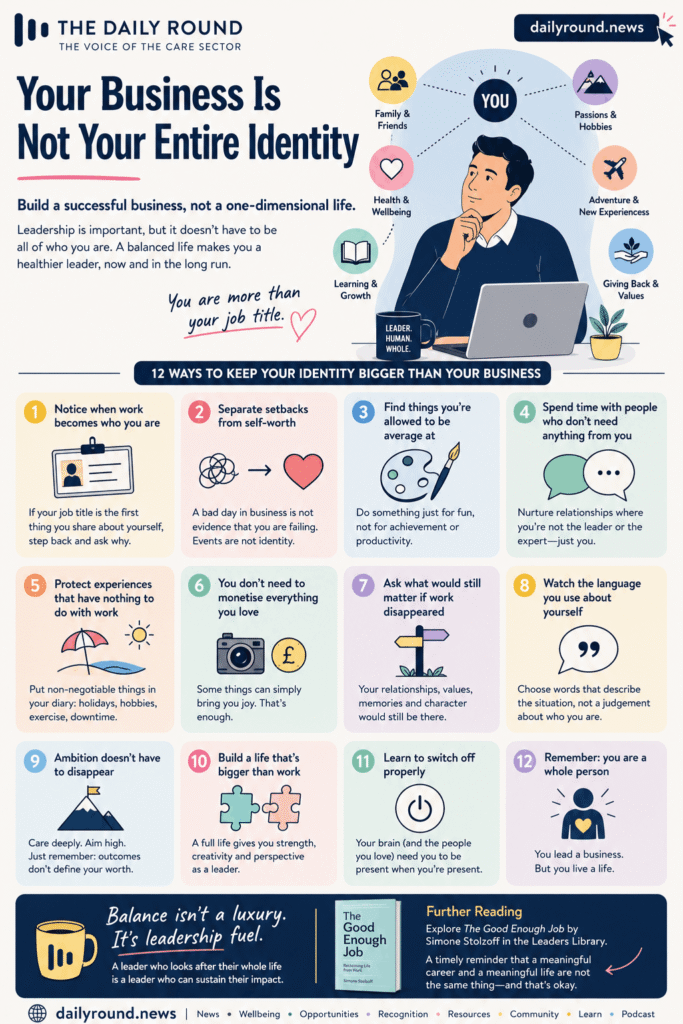
For many leaders, probably not very long. Work occupies a huge amount of our time, but when you run a business or lead an organisation, it can occupy something else too: your identity. You don’t simply go to work; you’re responsible for it. Its successes feel personal, its problems follow you home and its future can become tangled up with your own sense of success.
That isn’t necessarily a bad thing. Caring deeply about what you do can provide purpose, motivation and enormous satisfaction. Building something you’re proud of is an achievement worth celebrating. The difficulty comes when the line between “this is something important that I do” and “this is who I am” begins to disappear.
Because businesses have bad days. Leaders make mistakes. Clients leave. Targets get missed. Careers change. And if your entire sense of self is sitting inside your professional life, every business setback has the potential to feel like a personal one.
There is a particular intensity that comes with leadership because work rarely stays neatly contained within working hours. Even when you’re not physically working, you may be thinking about it. A conversation from earlier plays through your head while you’re making dinner. You check an email while watching television. An idea arrives while you’re trying to sleep. You find yourself discussing the business over lunch with somebody who didn’t actually ask.
Gradually, work can expand into every available space.
The same thing can happen socially. You introduce yourself through your job title. Your professional achievements become the easiest way to measure how well life is going. When somebody asks what you’ve been doing recently, almost everything you have to talk about happened at work.
Eventually, a difficult question emerges: who are you when you’re not working?
If that question is surprisingly difficult to answer, it might be worth paying attention to.
When you’re deeply connected to your work, professional success can produce an enormous emotional high. You win the contract, reach the target, receive recognition or watch something you’ve built grow and it feels fantastic.
The downside is that the opposite can become equally powerful.
A lost client isn’t simply a commercial event; it feels like rejection. A disappointing month becomes evidence that you’re failing. Criticism of the organisation feels like criticism of you personally. Somebody leaving the business can feel almost like a betrayal.
Of course leaders should care about outcomes. Indifference isn’t the goal.
But there is a useful emotional distance between “something went wrong” and “I am a failure.”
Those statements are not the same thing.
One describes an event. The other turns the event into an identity.
This can be uncomfortable to think about, particularly when you’re in the middle of building something, but no professional role lasts forever.
Companies are sold. Careers change. People retire. Organisations restructure. Industries evolve. Sometimes people simply wake up one day and realise they want something different.
If all of your identity has been invested in being a CEO, founder, director, clinician, manager or business owner, losing or leaving that title can create a surprisingly large hole.
That doesn’t mean you should care less about your career. It means allowing other parts of yourself to exist alongside it.
You were a person before you had your current job title, and you’ll still be one when you no longer have it.
Leadership can create an expectation of competence. People come to you because you’re supposed to know things, decide things and be good at things.
Which makes it particularly healthy to occasionally do something you’re absolutely terrible at.
Take up a hobby. Learn a language. Try painting. Play a sport badly. Grow vegetables that inexplicably refuse to grow. Cook something ambitious that ends up looking nothing like the photograph.
Not everything needs to become another area in which you excel.
There is something wonderfully freeing about doing something purely because you enjoy it rather than because you’re trying to achieve, monetise, optimise or win.
Your hobbies don’t need KPIs.
Leadership relationships often contain an element of responsibility. Employees need decisions. Clients need results. Suppliers need answers. Partners need information. Your professional network may genuinely care about you, but the relationship still exists partly because of work.
That’s why relationships outside your professional world matter.
Spend time with people who don’t care about your quarterly figures, don’t know what your latest business problem is and aren’t particularly impressed by your job title. People with whom you can talk about films, football, books, holidays, terrible television, family gossip or absolutely nothing of consequence.
It can be grounding to spend time somewhere you’re not the leader.
You’re simply you.
When businesses become demanding, personal life is often the first thing leaders start borrowing time from.
You cancel dinner because something has come up. You work through the weekend because there’s a deadline. You answer emails on holiday because it will “only take five minutes”. Exercise disappears, hobbies get postponed and friendships become something you’ll make more time for when work calms down.
Sometimes that is unavoidable. Leadership occasionally requires sacrifice.
The problem is when temporary sacrifice quietly becomes your permanent lifestyle.
There will probably never be a moment when your organisation has absolutely nothing left for you to do. If you wait for work to be finished before giving proper attention to the rest of your life, you could be waiting indefinitely.
Put some things in the diary that the business doesn’t get to take.
Modern culture has developed a slightly strange relationship with hobbies.
Enjoy baking? Start selling cakes. Love photography? Build a side business. Good at crafting? Open an online shop. Like writing? Start thinking about how to monetise it.
There is nothing wrong with turning something you love into a business. Plenty of brilliant companies begin exactly that way.
But you’re also allowed to enjoy something without asking it to generate revenue.
Not every interest needs to become another income stream, personal brand or productivity opportunity. Some things can simply make your life nicer.
That’s enough.
This isn’t an invitation to imagine your business collapsing. It’s simply a useful thought experiment.
If your current job disappeared tomorrow, what would still be there?
Your relationships. Your interests. Your personality. Your values. Your experiences. The places you’ve been. The things you’ve learned. The people you’ve helped. The things that make you laugh. The parts of yourself that existed long before your current role.
Those things deserve investment too.
A successful career can be an important part of a good life, but it doesn’t have to carry the entire responsibility for making life meaningful.
That’s a lot to ask from a job.
Pay attention to what happens internally when work isn’t going well.
Language matters because leaders can accidentally turn commercial events into judgements about their own worth.
You can make a bad decision without being a bad leader. You can lose something without being a loser. You can experience a difficult year without having a difficult life.
Work matters. But it doesn’t get to decide everything you believe about yourself.
Separating your identity from your work doesn’t mean becoming less ambitious.
You can want to build something extraordinary. You can work incredibly hard, set enormous goals, take calculated risks and care passionately about what happens next.
The difference is knowing that the outcome doesn’t determine your value as a person.
That distinction may actually make ambition healthier. If failure isn’t an existential threat to your identity, it becomes easier to take risks, learn from mistakes and recover when something doesn’t work.
The business can have a bad day without you becoming a bad day.
In The Good Enough Job, Simone Stolzoff explores our relationship with work and questions how much identity, purpose and meaning we should expect our jobs to provide. It’s a valuable addition to our Leaders Library because the question becomes particularly interesting when you’re responsible for an organisation rather than simply employed by one.
Perhaps the goal isn’t to care less about work.
Perhaps it’s to build a life containing enough other things that work doesn’t have to provide everything.
Be ambitious. Build things. Lead people. Chase opportunities. Celebrate the wins and care when things go wrong.
But also go somewhere without your laptop. Read something that has nothing to do with your industry. Have dinner with people who don’t want to discuss business. Take a holiday. Find a hobby you’re terrible at. Make memories that will never appear on your CV.
Your business can be enormously important to you.
It just doesn’t have to be all of you.
Wellbeing looks different for everyone, and sometimes the most useful thing is simply finding the right information at the right time. Explore more from Daily Round with our dedicated Women’s Health, Men’s Wellbeing and Wellbeing for Leaders sections, or head to the Leaders Library for our latest book recommendations, ideas and inspiration for life in and outside work.
Posted by:
Mehala
Editorial Assistant – The Daily Round
Busy day? We’ve got you covered. Get FREE daily news, practical insights, opportunities and wellbeing content, carefully curated for busy health and social care professionals. Just enter your details below to get The Daily Briefing delivered straight to your inbox.
 newsdesk@dailyround.news