
 newsdesk@dailyround.news
Industry Insight

In-depth articles exploring the trends, challenges, innovations and opportunities shaping the care sector—helping you stay informed and make smarter decisions.

Artificial intelligence is becoming an increasingly familiar part of healthcare, whether it is helping clinicians navigate complex information, supporting administrative tasks, or enabling patients to better understand their health.
Now, the company behind ChatGPT, OpenAI, is making it clear that healthcare professionals will play a vital role in shaping how the technology develops.
Health has become one of the most common reasons people use ChatGPT. Speaking about the company’s direction, OpenAI CEO Sam Altman has repeatedly highlighted healthcare as one of the platform’s most significant use cases, with millions of people already turning to AI to better understand symptoms, prepare for medical appointments, interpret test results and navigate treatment options.
The company says the next generation of AI should not replace healthcare professionals. Instead, it believes clinicians, nurses and other healthcare experts should help improve, evaluate and guide how these tools are developed and used.
OpenAI has stressed that AI is designed to support clinical decision-making rather than replace professional judgement.
The company has been working with healthcare organisations, researchers and clinicians to evaluate how its models perform in real-world healthcare scenarios. One example is HealthBench, an evaluation framework developed with input from around 250 physicians to assess how AI responds to realistic medical tasks.
OpenAI has also said that improving healthcare AI requires continuous feedback from medical professionals to ensure responses are accurate, safe and clinically useful.
Earlier this year, OpenAI announced ChatGPT Health, a dedicated health experience that allows users to connect information from medical records, wellness applications and wearable devices to personalise health conversations.
According to the company, users’ connected health data is excluded from AI model training by default, and additional security measures such as multi-factor authentication are available.
Alongside new products, OpenAI has also launched initiatives aimed at supporting healthcare systems internationally, including Horizon1000, a programme focused on helping strengthen primary healthcare through responsible AI deployment in partnership with governments and healthcare leaders.
Artificial intelligence is unlikely to replace the knowledge, judgement and compassion of healthcare professionals. However, it is increasingly becoming another tool that clinicians can use to improve efficiency, reduce administrative burden and help patients better understand their health.
As adoption continues to grow, many experts believe the quality and safety of healthcare AI will depend on meaningful collaboration between technology companies and the professionals who deliver care every day.
For healthcare organisations, this presents an opportunity not only to adopt AI responsibly but also to help shape how it evolves. The insight and experience of frontline staff will be essential in ensuring future AI systems are accurate, trustworthy and designed around the realities of clinical practice.
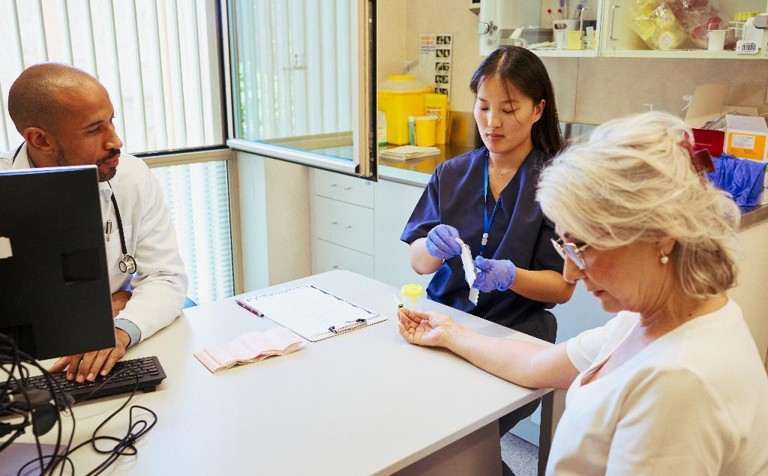
Image for illustrative purposes only and may not depict the people, service or location featured in this article.
Posted by:
Mehala
Editorial Assistant – The Daily Round



Sign up to receive daily insights, sector news, and opportunities. Tell us a little about yourself below so we can personalise what you receive.
Sign up to receive daily insights, sector news, and opportunities. Tell us a little about yourself below so we can personalise what you receive.