

Leadership in Practice

Practical guidance, tools, and best practice to help care sector leaders manage people, develop staff, navigate compliance, and lead with confidence every day.




The first three months of employment can determine whether someone stays for years or starts looking for their next job.
Recruitment is expensive, time-consuming and increasingly challenging across healthcare and social care. Yet while organisations invest significant time attracting new employees, many unintentionally overlook the most important part of the journey: what happens after someone accepts the job.
The first 90 days shape first impressions, confidence, engagement and long-term loyalty. A positive onboarding experience doesn’t just help people settle in, it helps them stay.
Starting a new role can be overwhelming. New employees are learning policies, procedures, technology, colleagues, workplace culture and often entirely new ways of working, all at the same time.
It’s also the period when they begin asking themselves important questions:
The answers to those questions often determine whether they remain engaged or begin looking elsewhere. Retention starts on day one, not after the probation period.
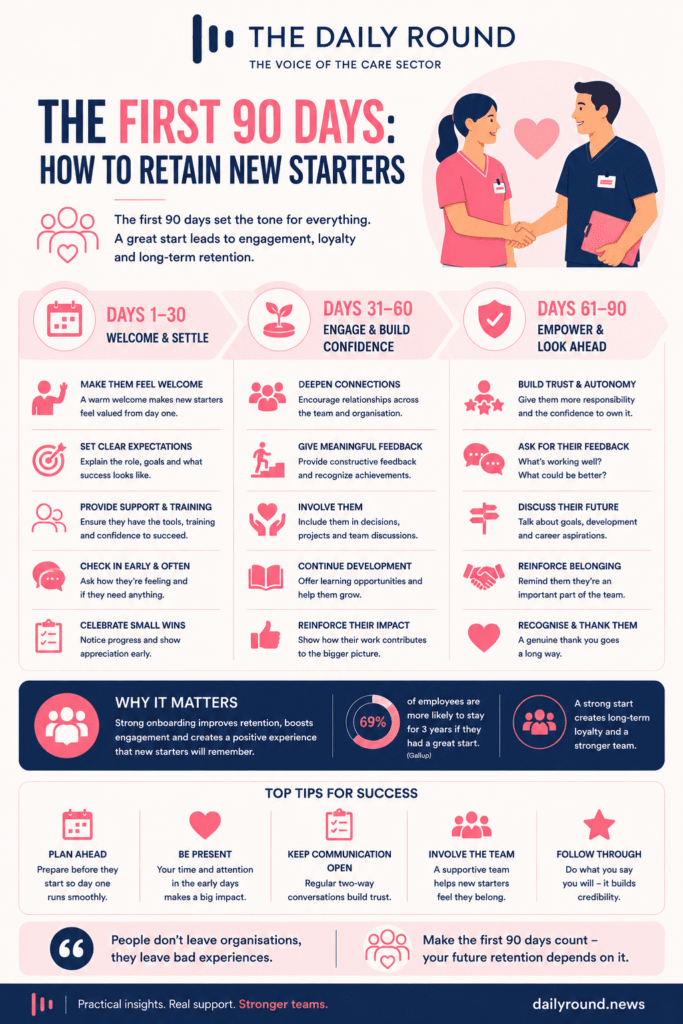
The first month should focus on making people feel welcomed, supported and prepared. A warm introduction, organised induction and regular check-ins can make an enormous difference to confidence.
New starters should know:
It’s easy to assume people will “find their feet.” Great employers help them do exactly that.
As new employees become more familiar with their role, leaders should begin focusing on development rather than simply orientation. Constructive feedback, coaching and opportunities to contribute help people feel valued. This is also the perfect time to encourage relationships across the wider team.
Feeling connected to colleagues is one of the strongest predictors of employee engagement and retention.
By the third month, employees are beginning to picture what their future within the organisation might look like. Managers should use this opportunity to discuss career aspirations, development opportunities and longer-term goals.
Simple conversations such as:
show employees that they’re more than just another member of staff. They’re someone worth investing in.
Retaining new starters doesn’t always require expensive programmes. Often, it’s the small moments that people remember.
Recognition during the early weeks helps new employees feel seen, appreciated and part of the team.
Even organisations with good intentions can unintentionally create poor onboarding experiences. Some of the most common mistakes include:
Consistency matters far more than perfection.
When organisations lose employees within their first year, the reasons often began long before the resignation letter arrived. The first 90 days provide an opportunity to build trust, confidence and commitment. Employees who feel welcomed, supported and valued are far more likely to become engaged, productive members of the team.
The organisations with the strongest retention rates don’t simply recruit well. They onboard well.
Every new starter arrives excited about a fresh opportunity. They want to succeed, make a difference and feel part of something bigger.
As leaders, we have a choice. We can hope they’ll settle in on their own, or we can intentionally create an experience that makes them feel welcomed from the very beginning. People rarely remember every training session they attended. They remember how they were treated.
Get the first 90 days right, and you’ll build more than retention, you’ll build loyalty, confidence and a culture that people want to be part of.
Join organisations across health and social care that are investing in happier, healthier workplaces with the Daily Round Wellbeing Employer programme.
Download our Employer Wellbeing Brochure to discover what’s included, or become a Daily Round Wellbeing Employer today.
Posted by:
Mehala
Editorial Assistant – The Daily Round
Busy day? We’ve got you covered. Get FREE daily news, practical insights, opportunities and wellbeing content, carefully curated for busy health and social care professionals. Just enter your details below to get The Daily Briefing delivered straight to your inbox.
 newsdesk@dailyround.news