

Leadership in Practice

Guidance, inspiration, and practical support to help leaders manage wellbeing, build resilience, overcome challenges, and maintain a healthy work-life balance.




It’s 2.17am. The house is quiet, everybody else is asleep and your brain has decided this is the perfect moment to conduct a full strategic review of the business.
You start with one relatively innocent thought. Did that client ever reply to the email? That reminds you of the invoice they haven’t paid. Which makes you think about cash flow. Which makes you remember payroll. Then you start wondering whether you need another member of staff, whether you’ve got too many members of staff, whether that meeting yesterday went badly and whether the person who seemed slightly quiet at 3pm is secretly planning to resign.
By 2.43am, you’ve mentally restructured the organisation, lost three imaginary clients, predicted a financial crisis that hasn’t happened and rehearsed a difficult conversation with somebody who is currently fast asleep and completely unaware they’re participating.
Welcome to leadership at 2am.
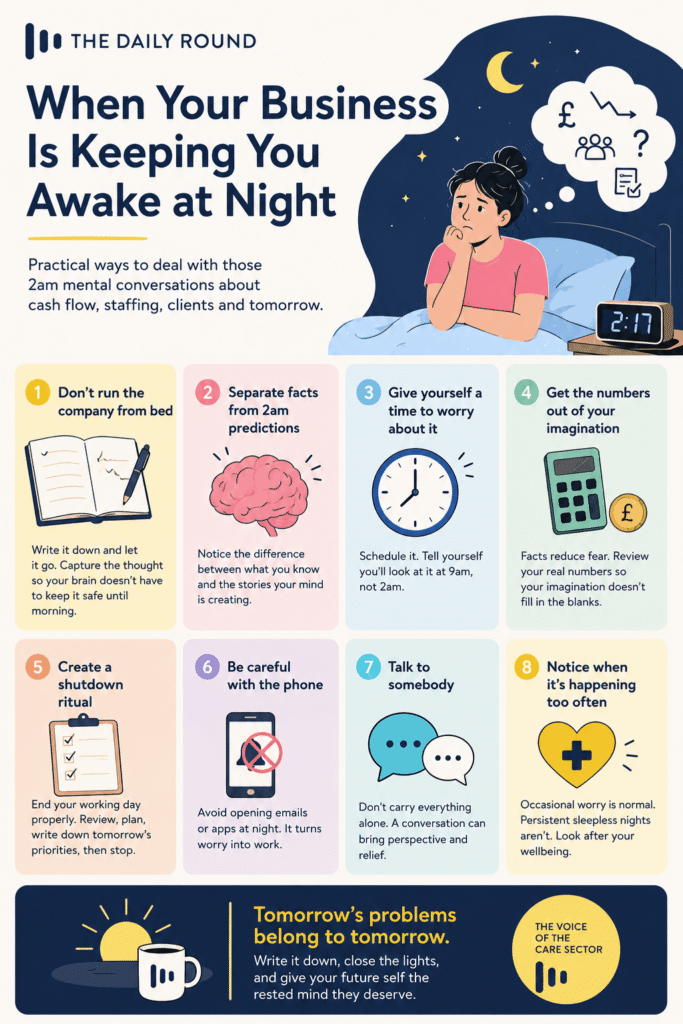
Business problems have an annoying habit of becoming considerably more dramatic when you’re lying in the dark.
During the working day, you have context. You can check the numbers, speak to somebody, send an email, make a decision or take action. At 2am, most of those options disappear. You’re left with the problem but none of the useful tools for solving it.
That creates perfect conditions for rumination. Instead of moving towards a solution, your mind goes around the same issue repeatedly, often adding increasingly catastrophic possibilities along the way.
A late-paying invoice becomes a cash-flow problem. The cash-flow problem becomes a terrible month. The terrible month becomes a terrible year. Before long, your perfectly functional business has somehow collapsed before breakfast.
The problem may be real. The conclusions your exhausted brain is drawing from it may not be.
When you’re worried about something, the temptation is to solve it immediately. You start calculating figures in your head, planning conversations and working through different scenarios.
Usually, this isn’t particularly productive.
There are very few business decisions that improve because they were made while sleep-deprived in the middle of the night. If there is something you genuinely need to deal with tomorrow, write it down. Keep a notebook beside the bed or use a quick note on your phone if you can do so without disappearing into emails and notifications.
The act of recording the thought can help because you’re no longer asking your brain to remember it until morning.
You’re not ignoring the problem. You’re scheduling it for a time when you’re actually capable of doing something about it.
When anxiety takes over, facts and predictions can start becoming indistinguishable.
Perhaps a major client hasn’t renewed yet. That’s a fact.
“They’re definitely leaving, we’re going to miss our target and I’ll have to make people redundant” is a prediction.
Perhaps an employee seemed unhappy yesterday. That’s something you noticed.
“They’re going to resign and the whole team will fall apart” is a story your brain has constructed around it.
When you’re lying awake worrying, try asking yourself a simple question: What do I actually know?
Separating what has genuinely happened from what you’re predicting might happen can shrink an enormous problem back down to its actual size.
Telling yourself to “stop worrying” is rarely effective. If anything, your brain seems to interpret the instruction as evidence that the subject deserves even more attention.
Instead, give the problem an appointment.
Tell yourself that you’ll look at the cash-flow forecast at 9am. You’ll speak to the employee tomorrow afternoon. You’ll review the client account after your first meeting. You’ll make the decision when you have the information you need.
This gives your brain a slightly different message: this matters, but it doesn’t need to be solved now.
There is a considerable difference between avoiding a problem and postponing it until you’re in a position to deal with it properly.
Money is particularly good at keeping business owners awake because uncertainty allows the imagination to take over.
If cash flow regularly occupies your thoughts at night, having a clear financial picture during the day can reduce some of that uncertainty. Know what’s in the bank, what is due in, what is due out and what your genuine exposure looks like.
The numbers may occasionally be uncomfortable, but concrete information is generally easier to deal with than vague financial dread.
If there is a problem, you can make a plan. If there isn’t, you have evidence to challenge the 2am version of events.
The same applies to other recurring worries. If staffing keeps you awake, look at your actual capacity and recruitment plans. If sales are worrying you, review the genuine pipeline. If you’re concerned about a client, establish what you actually know about the relationship.
Turn anxiety into information wherever you can.
One reason work follows leaders into bed is that there is rarely a clear moment when the working day officially finishes.
Employees may leave an office, shut down their computer or finish a shift. Leaders can finish work physically while continuing it mentally for another six hours.
Creating a small end-of-day routine can help draw a line underneath the working day. Review anything unfinished, write down tomorrow’s priorities, record problems that need attention and decide what your first task will be when you return.
Then stop.
The objective isn’t to have solved everything. It’s to reassure yourself that the unfinished things have somewhere to live overnight other than inside your head.
Reaching for your phone at 2am because you’re worried about work can turn a difficult 20 minutes into a very long night.
One email leads to another. Then you check the bank account, look at tomorrow’s calendar, read a message and perhaps even send a response. Your brain receives a fairly clear signal: apparently we’re working now.
Unless something genuinely requires immediate action, resist opening work apps during the night. If you need to capture a thought, write it down and leave everything else until morning.
The email will still be there.
Leadership can be surprisingly lonely when things aren’t going well.
There are problems you may not want to discuss with employees because you don’t want to worry them. You may not want to burden your family with every business concern. And sometimes you feel as though you’re supposed to be the calm person who already knows what to do.
That can leave an awful lot happening privately inside your head.
Having somebody you can speak openly to — a business partner, mentor, peer, coach, adviser or trusted friend — can provide perspective that is difficult to create alone. Sometimes you need advice. Sometimes you simply need to say the thing out loud and hear how it sounds outside your own thoughts.
A problem that feels enormous at 2am can become surprisingly manageable during a 10am conversation.
Every leader will occasionally lose sleep over work. A major deadline, financial pressure, difficult staffing situation or important decision can temporarily follow you into the night.
But regularly lying awake worrying about work deserves attention.
Persistent sleep problems can affect concentration, mood, judgement and your ability to cope with stress — precisely the things you need when you’re responsible for making important decisions. If sleep difficulties continue or begin significantly affecting everyday life, it’s worth seeking professional advice rather than simply accepting poor sleep as part of being successful.
Leadership may involve pressure, but chronic exhaustion shouldn’t be treated as a badge of honour.
There will always be something happening in a business.
A client will leave. Somebody will resign. An unexpected bill will arrive. A target will be missed. A brilliant opportunity will appear at the worst possible moment. Something that looked disastrous will turn out to be completely manageable, and something you never thought to worry about will appear from nowhere.
You cannot eliminate uncertainty from leadership.
What you can do is decide whether every possible future problem deserves access to you in the middle of the night.
Write down what needs dealing with. Separate the facts from the predictions. Remind yourself when you’ll take action and allow tomorrow’s version of you — rested, informed and able to actually do something — to handle it.
Your business needs you tomorrow. It doesn’t need you running it from bed at 2am.
Wellbeing looks different for everyone, and sometimes the most useful thing is simply finding the right information at the right time. Explore more from Daily Round with our dedicated Women’s Health, Men’s Wellbeing and Wellbeing for Leaders sections, or head to the Leaders Library for our latest book recommendations, ideas and inspiration for life in and outside work.
Posted by:
Mehala
Editorial Assistant – The Daily Round
Busy day? We’ve got you covered. Get FREE daily news, practical insights, opportunities and wellbeing content, carefully curated for busy health and social care professionals. Just enter your details below to get The Daily Briefing delivered straight to your inbox.
 newsdesk@dailyround.news