

Everyday Wellbeing

Advice, information, and resources to help women navigate every stage of life, supporting both physical and mental wellbeing.



For many women diagnosed with ADHD in adulthood, the diagnosis can bring an unexpected mixture of relief, sadness and recognition. Behaviours they may have spent years describing as disorganisation, forgetfulness, overwhelm or simply “not coping as well as everyone else” can suddenly be viewed through a very different lens.
Attention deficit hyperactivity disorder (ADHD) is a neurodevelopmental condition that begins in childhood, but that does not mean it is always identified during childhood. Historically, much of our understanding of ADHD was shaped by the behaviours most readily noticed in boys, particularly hyperactivity, impulsivity and disruption. Girls whose difficulties presented differently could therefore pass through school without anybody considering ADHD.
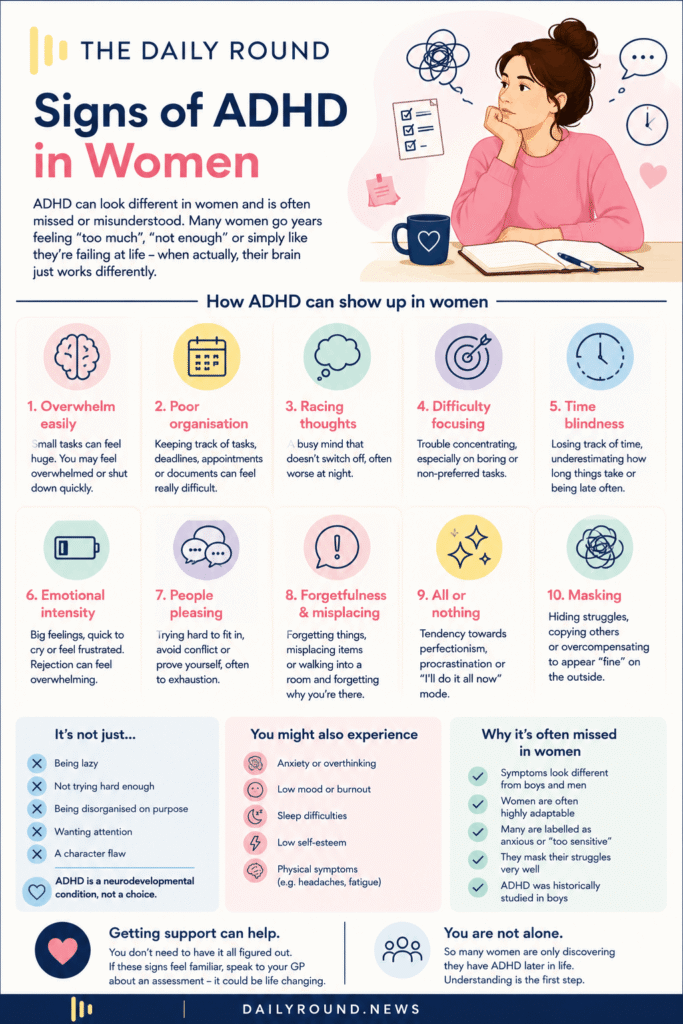
The stereotype of a child with ADHD is still often an energetic boy who cannot sit still in class. Yet ADHD does not always look like that. Some girls may experience difficulties with attention, organisation, working memory or impulsivity without displaying the obvious external hyperactivity that attracts attention from teachers or parents.
A girl may be daydreaming rather than disrupting the lesson. She might constantly lose things, forget homework, struggle to begin assignments or leave everything until the last minute, while still achieving good grades. Others may talk excessively, interrupt conversations or experience intense emotions, but these behaviours can be interpreted as personality rather than signs of an underlying condition.
Girls can also become skilled at compensating for their difficulties. They may work much harder than their peers to stay organised, rely heavily on routines or reminders, copy the behaviours of others or become perfectionistic because they are frightened of making mistakes.
From the outside, everything can appear perfectly fine. Internally, maintaining that appearance may require an enormous amount of effort.
For some women, ADHD only becomes apparent when the structures that helped them cope earlier in life disappear.
School and university provide timetables, deadlines and external accountability. Adulthood can bring a very different level of responsibility. Careers become more demanding, households need managing, finances require attention and relationships bring their own emotional and practical responsibilities.
Motherhood can be a particularly significant turning point. Suddenly there are appointments, school messages, uniforms, meals, activities, birthdays and countless pieces of information to remember, often alongside paid employment and household responsibilities.
A woman who previously managed her own life reasonably successfully may find managing several people’s lives profoundly difficult. The systems she relied upon can begin to buckle under the sheer volume of competing demands.
This is sometimes when the question emerges: Why does everyone else seem able to manage this when I find it so exhausting?
One of the reasons ADHD can remain unnoticed is that some women develop remarkably effective ways of compensating for their difficulties.
A woman who is terrified of being late may arrive everywhere 30 minutes early. Someone frightened of forgetting appointments may maintain several calendars, alarms and lists. A person who struggles with deadlines may repeatedly work late into the night because urgency is the only thing that enables them to focus.
These strategies can work, sometimes for decades. But functioning is not necessarily the same as functioning comfortably.
Behind an apparently organised life there can be chronic stress, exhaustion and a persistent feeling of being one mistake away from everything falling apart.
Women who have spent years compensating may also be particularly hard on themselves. Instead of recognising that certain tasks genuinely require more effort, they may conclude that they are lazy, careless or incapable. Repeatedly hearing phrases such as “you have so much potential” or “you just need to be more organised” can reinforce that belief.
There is growing interest in the relationship between ADHD symptoms and hormonal changes throughout a woman’s life.
Some women report changes in concentration, memory, mood and executive functioning around their menstrual cycle, during pregnancy and following childbirth. Perimenopause and menopause can create another significant period of change, particularly because symptoms such as brain fog, forgetfulness and difficulty concentrating can overlap with experiences associated with ADHD.
For some women, midlife is therefore the point at which long-standing difficulties become considerably harder to manage.
Research into the interaction between female hormones and ADHD remains an evolving area, and not every change in concentration or memory is evidence of ADHD. However, greater recognition of women’s experiences is helping clinicians and researchers ask questions that historically received far less attention.
TikTok, Instagram and other social platforms have played a significant role in raising awareness of ADHD in adult women. For some people, hearing another woman describe an experience remarkably similar to their own has been the first reason they have considered seeking professional advice.
That increased awareness has undoubtedly helped some people who might otherwise have continued struggling without support. But it has also created challenges.
Forgetfulness, procrastination, distraction and feeling overwhelmed are human experiences. They can also occur because of stress, anxiety, depression, poor sleep, menopause, physical illness and numerous other factors. Relating to an ADHD video online is not the same as receiving a diagnosis.
A proper assessment considers symptoms across a person’s life, whether difficulties were present during childhood and, importantly, whether they have a significant impact across areas such as work, education, relationships or everyday functioning.
The workplace can expose both the challenges and strengths associated with ADHD.
Some women may struggle with administrative tasks, prioritising competing demands, lengthy meetings, managing email, estimating how long work will take or maintaining concentration on repetitive tasks. Others can find themselves alternating between periods of difficulty focusing and periods of intense concentration on something that captures their interest.
The experience is highly individual, and an ADHD diagnosis does not determine somebody’s ability or potential. Many adults with ADHD develop careers in demanding professions and leadership roles.
The difficulty can arise when somebody is achieving externally while privately using an unsustainable amount of energy to do so.
Greater awareness among employers can therefore be valuable. Clear priorities, written instructions, appropriate technology, quieter working environments or flexibility in how certain tasks are completed may make a meaningful difference for some employees.
Receiving an ADHD diagnosis at 35, 45 or 55 can prompt women to revisit decades of their lives.
There can be relief in finally having an explanation for experiences that previously felt like personal failings. There can also be grief.
Some women wonder how different school might have been if somebody had noticed. Others think about careers they abandoned, relationships that were affected or years spent believing they simply needed to “try harder”.
Neither a diagnosis nor the absence of one changes everything that came before. But understanding why certain things may have been difficult can allow somebody to view their history with greater context rather than simply through the lens of failure.
The growing conversation around ADHD in women is important precisely because a group of people may historically have been overlooked. But better recognition should not mean treating every distracted, overwhelmed or forgetful woman as though she has the condition.
Modern life is demanding. Caring responsibilities, work pressures, financial worries, poor sleep, hormonal changes and constant digital interruptions can leave almost anybody feeling as though their brain has too many tabs open.
ADHD is a recognised neurodevelopmental condition, and diagnosis requires much more than identifying with a checklist online.
For women who have experienced persistent difficulties with attention, organisation, impulsivity or executive functioning stretching back to childhood and affecting everyday life, speaking to a healthcare professional can be an appropriate starting point.
Perhaps the biggest change is simply that more women are now part of the ADHD conversation.
For generations, the image of ADHD did not necessarily look like them. As our understanding becomes broader, women who spent years quietly wondering why everyday life seemed to require so much effort may finally be getting some answers.
Wellbeing looks different for everyone, and sometimes the most useful thing is simply finding the right information at the right time. Explore more from Daily Round with our dedicated Women’s Health, Men’s Wellbeing and Wellbeing for Leaders sections, or head to the Leaders Library for our latest book recommendations, ideas and inspiration for life in and outside work.
Or, if you’re ready to get back to what’s happening across the sector, catch up with today’s Daily News for the latest health and social care stories.
Posted by:
M Ramalani
Editorial Assistant – The Daily Round
Busy day? We’ve got you covered. Get FREE daily news, practical insights, opportunities and wellbeing content, carefully curated for busy health and social care professionals. Just enter your details below to get The Daily Briefing delivered straight to your inbox.
 newsdesk@dailyround.news