

Women's Health

Practical tips, guidance, and inspiration to support your physical, mental, and emotional wellbeing every day.




There are some relationships we’re taught to believe are supposed to last forever. Parents. Children. Brothers and sisters. The people who knew us before anybody else did. So, when one of those relationships breaks down, whether through one enormous event or a thousand smaller ones, he loss can be extraordinarily difficult to explain.
Family estrangement is more common than we tend to talk about, yet it can carry an enormous amount of shame. People may go years without speaking to a parent, sibling or adult child while colleagues and friends know absolutely nothing about it. When somebody casually asks what you’re doing for Mother’s Day, whether you’re going “home” for Christmas or how your brother is doing, you learn how to navigate the question without opening a door you don’t particularly want to walk through.
Estrangement isn’t always loud. Sometimes the hardest part is how quietly it sits alongside the rest of your life.
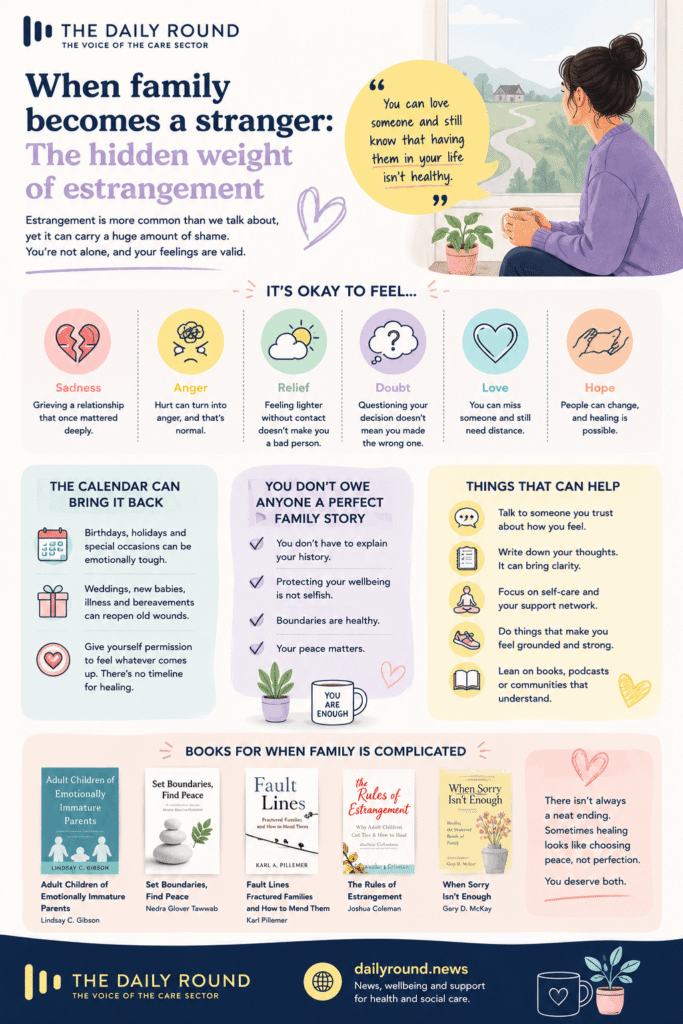
One of the most confusing things about estrangement is that apparently contradictory feelings can exist at exactly the same time.
You can love somebody and know that having them in your life isn’t healthy. You can be angry with somebody and still desperately miss them. You can know exactly why you stopped speaking and occasionally wonder whether you made the right decision. You can feel enormous relief after contact ends and then unexpectedly grieve the relationship months or years later.
None of those feelings necessarily cancels out another.
Family estrangement can involve a peculiar form of grief because the person you’re grieving may still be alive. There isn’t necessarily a funeral, a socially recognised period of mourning or a clear ending. Instead, there can be an ongoing loss – not only of the relationship you actually had, but sometimes of the relationship you hoped you might eventually have.
Perhaps that’s the parent you kept hoping would finally understand you. The sibling relationship you imagined you’d have as adults. The grandparent you thought your children would know. Sometimes we’re grieving what happened. Sometimes we’re grieving what never did.
You can be perfectly content with an estrangement for months and then suddenly find yourself floored by a date.
Birthdays can do it. Christmas is particularly good at it. Mother’s Day and Father’s Day arrive accompanied by weeks of advertising about perfect families, while weddings, new babies, illnesses and bereavements can reopen questions you thought you’d already answered.
Should I contact them?
What if something happens and I regret this?
What if they’ve changed?
What if they haven’t?
There isn’t a universal answer. Reconciliation can be wonderful where both people genuinely want it and where the relationship can become healthier. But reconciliation isn’t automatically the morally superior outcome, and being related to somebody doesn’t mean you have to repeatedly accept behaviour that causes you harm.
Equally, people who want to repair an estranged relationship shouldn’t feel embarrassed about that either. Sometimes relationships do change. People grow older, circumstances alter, apologies happen and boundaries that once seemed impossible become possible.
The important thing is that decisions about contact should be based on the reality of the relationship, not simply guilt about what families are “supposed” to look like.
Perhaps one of the greatest burdens of family estrangement is how invisible it can be.
Someone can walk into work, answer emails, care for patients, manage a team and laugh with colleagues while privately carrying an enormously complicated family situation. They may be dealing with guilt, anger, rejection or grief that nobody around them knows exists.
That’s particularly worth remembering in workplaces built around caring for other people. Healthcare and social care professionals spend enormous amounts of emotional energy supporting patients, residents, families and colleagues. They aren’t immune from having complicated families of their own.
Sometimes the healthiest thing you can do is talk about it, not necessarily with the person you’re estranged from, but with somebody safe. A trusted friend, partner, counsellor or therapist can provide somewhere to unpack feelings that are difficult to explain elsewhere.
And sometimes a book can do something surprisingly similar.
If you’re navigating estrangement, boundaries or simply trying to understand why certain family relationships affect you so deeply, there are some excellent books worth spending time with.
Adult Children of Emotionally Immature Parents by Lindsay C. Gibson has become enormously popular for a reason. It explores what happens when parents struggle to respond to their children’s emotional needs and how those experiences can continue shaping relationships in adulthood. You don’t need to be estranged from a parent for the book to resonate.
Set Boundaries, Find Peace by Nedra Glover Tawwab is particularly useful if the word “boundaries” has always sounded good in theory but becomes considerably more difficult when you’re actually dealing with family. It’s practical, accessible and focused on communicating what you need rather than trying to control another person’s behaviour.
For something specifically focused on fractured families, Fault Lines by Karl Pillemer examines family estrangement through research and people’s lived experiences, including why relationships break down and what can happen when people attempt reconciliation.
And then there’s The Rules of Estrangement by Joshua Coleman, which approaches the subject particularly from the perspective of parents estranged from adult children. That perspective won’t be right for everyone, but it can offer insight into the experience on the other side of some estrangements.
Books won’t tell you whether you should call somebody.
They can’t know the history, the hurt, what has been said or how many chances have already been given. Be wary of anyone, author, influencer, friend or otherwise who thinks they can make that decision for you without understanding your circumstances.
What a good book can sometimes do is give you language for something you’ve been carrying around without knowing quite how to describe it.
Families are complicated because people are complicated.
Some estrangements eventually end. Others last for decades. Some people reconcile and build genuinely different relationships; others reconnect only to discover why distance became necessary in the first place. And some decide that peace exists precisely because contact doesn’t.
If you’re estranged from somebody in your family, you don’t have to explain the entire history every time somebody asks an innocent question. You don’t have to pretend you don’t care. And you don’t have to reconcile simply because somebody tells you that “family is everything.”
You are allowed to acknowledge that losing a family relationship hurts while also recognising that maintaining it may have hurt too.
Sometimes there isn’t a neat ending.
Sometimes there is simply learning how to carry the story a little more lightly.
Register with The Daily Round for the latest sector news, inspections & reports, wellbeing content, workforce insights, expert features and practical updates—delivered free to your inbox.
Posted by:
M Ramalani
Editorial Assistant – The Daily Round
Busy day? We’ve got you covered. Get FREE daily news, practical insights, opportunities and wellbeing content, carefully curated for busy health and social care professionals. Just enter your details below to get The Daily Briefing delivered straight to your inbox.
 newsdesk@dailyround.news