

Everyday Wellbeing

Advice, information, and resources to help women navigate every stage of life, supporting both physical and mental wellbeing.




People choose careers in healthcare and social care for many different reasons, but for most there is a common thread: they care about people. Whether you are a nurse, doctor, healthcare assistant, social worker, paramedic, support worker, therapist or care worker, a significant part of the job involves meeting people during moments when they are frightened, unwell, distressed, grieving or vulnerable. Providing compassionate support through those moments can be one of the most rewarding parts of working in care, but repeatedly absorbing other people’s pain can also take a toll.
There may come a point when the member of staff who was once endlessly patient begins to feel irritable. The person who always had time to listen finds themselves wishing a conversation would end. Someone who once went home thinking about their patients begins deliberately trying not to think about them at all. That change can be frightening, particularly for people who have always considered compassion an important part of who they are professionally.
It does not necessarily mean they have stopped caring. Sometimes it can mean they have been caring intensely for too long without enough opportunity to recover.
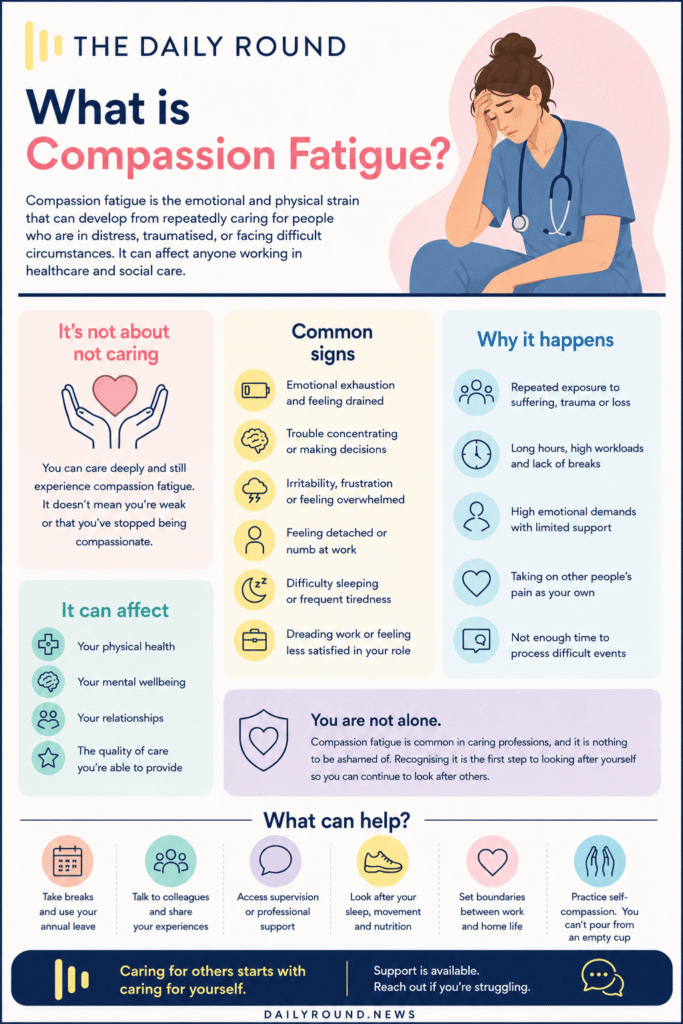
Compassion fatigue is a term used to describe the emotional and physical strain that can develop through repeated exposure to other people’s suffering. It is particularly associated with professions in which workers regularly support people experiencing trauma, illness, distress or loss, making healthcare and social care obvious environments in which it can occur.
It can develop differently from person to person. Some people describe feeling emotionally numb or detached, while others become unusually irritable or overwhelmed. Concentration can become harder, sleep may be affected and situations that would once have been manageable can suddenly feel disproportionately difficult. There may also be a sense of dread about going to work or a growing desire to distance yourself emotionally from the people you are supporting.
These reactions can be accompanied by guilt. Healthcare professionals are expected to be compassionate, so recognising that your emotional response to patients or service users has changed can feel deeply uncomfortable. Somebody may worry that they have become cold, impatient or simply unsuitable for the profession they once loved.
In reality, emotional resources are not unlimited.
One of the peculiar realities of healthcare is that an ordinary working day for a member of staff can contain several life-changing moments for other people.
A doctor may deliver devastating news before moving immediately to the next patient. A nurse may support a family following a death and then answer another call bell minutes later. A paramedic can leave one traumatic incident and be dispatched directly to another. A social care worker may repeatedly support people experiencing abuse, neglect, severe illness or profound loneliness.
There is rarely a natural period in which to process what has happened.
Healthcare professionals learn to compartmentalise because, to some extent, they have to. You cannot necessarily stop for an hour to process an upsetting experience when another person urgently needs your attention. Professionalism often requires putting your own emotions somewhere temporarily and continuing with the job.
The difficulty comes when “temporarily” becomes indefinitely.
Experiences can accumulate. A particularly distressing case may stay with somebody. Another may remind them of a member of their own family. Several difficult shifts can arrive together. Eventually, the emotional distance that helped somebody function can begin to feel less like a temporary professional boundary and more like numbness.
Compassion fatigue and burnout are often discussed together, and there can certainly be overlap, but they are not identical concepts.
Burnout is generally associated with chronic workplace stress and can occur in almost any profession. Excessive workload, inadequate staffing, lack of control, poor management, long hours and insufficient recovery can all contribute to somebody becoming physically and emotionally exhausted by work.
Compassion fatigue is more specifically connected to the emotional demands of repeatedly engaging with suffering and distress. Somebody can love their profession and work within a supportive team yet still find particular experiences emotionally difficult over time.
In healthcare, of course, the two can coexist. A nurse who is already exhausted because the ward is understaffed may have fewer emotional reserves available when dealing with a traumatic event. A care worker covering additional shifts may find it harder to remain patient with somebody displaying challenging behaviour. A paramedic who has had inadequate rest may have less capacity to process the emotional impact of another distressing call.
Workload and emotional exposure do not happen independently of each other. They can amplify one another.
Empathy is enormously valuable in healthcare. Feeling understood can influence how safe somebody feels, how openly they communicate and how they experience their care. But empathy also requires energy.
Listening properly to somebody who is frightened means being emotionally present. Supporting relatives through grief requires patience. Caring for somebody who is confused or distressed may require repeatedly providing reassurance, even when the same conversation has already happened several times.
Doing this occasionally is one thing. Doing it repeatedly across a long shift, and then returning the following day to do it again, is another.
Some workers begin protecting themselves without consciously deciding to do so. They may become more task-focused, avoid emotionally difficult conversations or feel less affected by situations that previously moved them deeply.
Some degree of professional emotional boundary is healthy and necessary. Healthcare workers cannot experience every patient’s pain as though it were their own.
The concern is when detachment becomes so pronounced that it begins affecting the worker’s wellbeing, relationships or ability to provide the standard of care they would normally expect from themselves.
One of the hardest parts of compassion fatigue can be recognising that you no longer respond emotionally in the way you think you should.
A colleague tells you something upsetting and you feel nothing. A patient begins crying and instead of immediately feeling sympathetic, your first thought is that you do not have time for another conversation. Somebody asks for help with something minor and you feel an unexpected flash of irritation.
Then comes the guilt.
Healthcare professionals can hold themselves to extraordinarily high emotional standards. They expect themselves to remain patient because the person receiving care is vulnerable. They understand that somebody who is frightened may be demanding or that somebody experiencing dementia may repeat themselves because they genuinely cannot remember.
Knowing why somebody is behaving in a particular way does not magically restore emotional energy.
Feeling irritated does not mean you will behave unprofessionally. Feeling emotionally numb does not mean you are incapable of compassion. Thoughts and feelings are not the same as actions.
But a noticeable change in how you feel about your work can be useful information. Rather than treating it as evidence that you are a bad healthcare professional, it may be a sign that you need support.
Most healthcare workers have probably encountered at least one patient they never completely forgot.
Sometimes there is something about a person’s story that stays with you. Perhaps they were the same age as your child. Perhaps their illness reminded you of your parent. Perhaps something about the circumstances felt particularly unfair.
You may think about them while driving home. You might wonder what happened after your shift ended or replay a difficult conversation in your head. In some circumstances, distressing experiences can also affect sleep or intrude into thoughts outside work.
The emotional boundary between professional and personal life can become particularly difficult when somebody is already dealing with problems at home. Supporting a patient through cancer while your own relative is receiving treatment, for example, may affect you differently from how it would at another point in your life.
Healthcare workers are professionals, but they are not emotionally neutral observers. They bring their own histories, families, fears and experiences into work with them.
That humanity is part of what enables compassionate care in the first place.
Compassion fatigue is not confined to hospitals.
In social care, staff can develop long-term relationships with the people they support. A care worker may visit the same person every morning for years. Support workers can become an important and consistent presence in someone’s life. Residential care staff may know residents and their families extremely well.
Those relationships can be deeply meaningful.
They can also make deterioration, bereavement and loss particularly difficult.
When somebody you have cared for over a long period dies, there may be little formal recognition of the worker’s grief. Another person still needs breakfast. Another visit remains on the rota. Another resident requires support.
Professional boundaries matter, but caring relationships are still relationships. It is entirely possible to understand that death and deterioration are part of the work while still being affected by them.
There can sometimes be an assumption that experienced healthcare workers simply become tougher.
To some extent, experience does help people develop professional boundaries and coping strategies. Situations that once felt overwhelming can become easier to manage as confidence grows.
But resilience should not mean becoming emotionally immune.
The goal is not to stop caring. It is to find a sustainable way of caring that does not require carrying every person’s suffering home with you.
That can involve recognising what belongs to you emotionally and what does not. You can provide somebody with excellent, compassionate care without being personally responsible for fixing everything happening in their life.
For people who entered healthcare precisely because they want to help, that boundary can sometimes be difficult to accept.
There is something uniquely reassuring about talking to somebody who understands the job.
Friends and family can be wonderfully supportive, but healthcare workers cannot always discuss the details of what they have encountered because of confidentiality. Even when they can speak generally, somebody outside the profession may struggle to understand why a particular situation has affected them so strongly.
Colleagues often understand without requiring much explanation.
A supportive team creates space for people to acknowledge difficult experiences rather than immediately pretending they did not happen. Informal conversations, appropriate debriefing after significant events, supervision and access to professional support can all provide opportunities to process some of the emotional impact of caring work.
This does not mean every difficult shift requires a formal intervention. It means people should not feel that being affected by something they witnessed is evidence that they are incapable of doing their job.
Sometimes saying, “That was really difficult,” and hearing somebody else say, “Yes, it was,” matters.
Individual wellbeing strategies have a place, but compassion fatigue cannot be treated solely as the employee’s responsibility.
Healthcare organisations need to consider the environments in which compassion is expected to flourish.
It is considerably harder to remain patient and emotionally available when somebody has worked excessive hours, missed their break and is covering gaps in an understaffed team. It is harder to process traumatic events when the workload allows no time for reflection. It is harder to seek help in a culture where admitting that something affected you is interpreted as weakness.
Employers can support staff through appropriate staffing, manageable workloads, access to supervision, psychologically safe leadership and meaningful support following particularly distressing incidents.
A wellbeing poster in the staff room cannot compensate for a system that repeatedly exhausts the people working within it.
If organisations want compassionate care, protecting the capacity of staff to provide that compassion has to be part of workforce planning.
Healthcare professionals can sometimes feel uncomfortable prioritising their own wellbeing because the needs of patients appear more urgent.
But the two are not competing interests.
Taking a proper break, using annual leave, establishing boundaries, talking about a difficult experience or asking for professional support does not mean somebody has become less committed to their patients.
It means recognising that a career in care is a marathon rather than a single heroic shift.
Outside work, ordinary things matter too. Sleep, movement, relationships, hobbies and time spent doing things completely unrelated to healthcare provide opportunities for the mind to occupy a world in which nobody is a patient and you are not responsible for fixing anything.
For somebody whose professional identity revolves around caring for others, remembering that there is an entire person underneath that role can be surprisingly important.
There will be difficult days in healthcare. Feeling upset after a traumatic incident or exhausted after an emotionally demanding run of shifts does not automatically mean somebody is experiencing compassion fatigue.
The concern is when changes persist.
If you feel increasingly detached from patients or service users, dread going to work, struggle to switch off after shifts or notice significant changes in your sleep, mood or relationships, it may be worth speaking to somebody.
Support might come through a manager, occupational health service, employee assistance programme, GP, professional body or mental health professional, depending on the circumstances and what feels appropriate.
Healthcare workers are often exceptionally good at recognising when somebody else needs help.
Applying the same judgement to themselves can be considerably harder.
We often talk about compassionate healthcare as though compassion simply exists whenever a good person comes to work.
In reality, compassion needs conditions in which it can survive.
It needs enough time to listen. It needs staff who are not completely exhausted. It needs teams where people can admit that something has affected them. It needs managers who recognise that healthcare workers are human beings rather than endlessly renewable sources of emotional support.
Most importantly, it requires us to abandon the idea that being affected by other people’s suffering is somehow a professional weakness.
If you have spent years sitting beside people on the worst days of their lives, some of those experiences may inevitably leave a mark.
The answer is not to care less.
It is to make sure the people providing that care are given enough support, space and humanity to continue caring without losing themselves in the process.
Wellbeing looks different for everyone, and sometimes the most useful thing is simply finding the right information at the right time. Explore more from Daily Round with our dedicated Women’s Health, Men’s Wellbeing and Wellbeing for Leaders sections, or head to the Leaders Library for our latest book recommendations, ideas and inspiration for life in and outside work.
Or, if you’re ready to get back to what’s happening across the sector, catch up with today’s Daily News for the latest health and social care stories.
Medical Disclaimer: The information provided in this article is for general information and wellbeing purposes only and is not intended to replace professional medical advice, diagnosis or treatment. If you are concerned about your health or experiencing persistent or worsening symptoms, please speak to a qualified healthcare professional. Always seek urgent medical attention if you believe you may be experiencing a medical emergency.
Posted by:
M Ramalani
Editorial Assistant – The Daily Round
Busy day? We’ve got you covered. Get FREE daily news, practical insights, opportunities and wellbeing content, carefully curated for busy health and social care professionals. Just enter your details below to get The Daily Briefing delivered straight to your inbox.
 newsdesk@dailyround.news