
 newsdesk@dailyround.news
UK News

<p>Stay up to date with the latest health and social care news from across the UK. From breaking stories and sector developments to the people, organisations and issues making the news.</p>
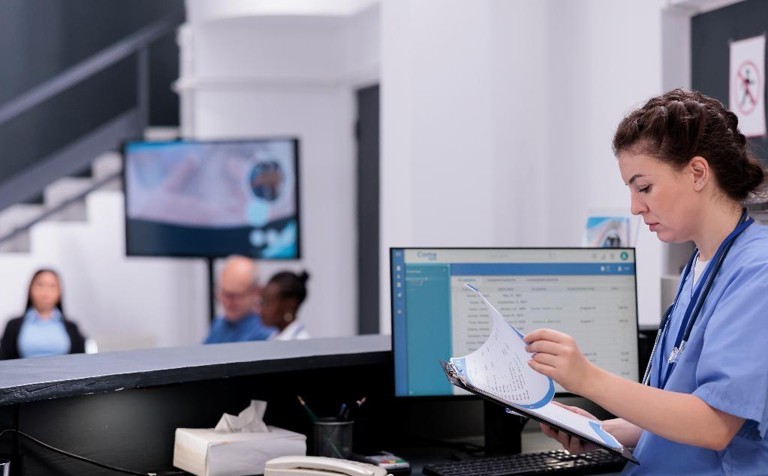
Nearly four in five NHS trusts in England continue to use paper patient records alongside digital systems, despite more than 25 years of efforts to modernise healthcare record keeping.
An investigation by the BMJ found that 79% of NHS trusts still use paper records in at least some areas of clinical care, while three quarters continue to rely on paper prescriptions. Researchers said the continued use of handwritten notes and paper documentation can contribute to inefficiencies, communication challenges and an increased risk of clinical errors.
The findings come as a separate report by the King’s Fund estimates the NHS spends around £240 million each yearstoring paper medical records in boxes, filing cabinets and off-site storage facilities. The think tank found that only five NHS trusts in England have fully digitised their patient records, while 209 NHS sites continue to rely entirely on paper documentation.
Although electronic patient record (EPR) systems have been introduced across much of the NHS, many organisations continue to operate hybrid paper and digital processes. NHS England says £1.9 billion has been invested in frontline digitisation, with the focus now shifting from implementing EPR systems to improving their usability and progressing towards a Single Patient Record.
Clinicians have warned that locating paper notes, interpreting handwritten records and working across multiple documentation systems can delay care and increase administrative burden. At the same time, some healthcare professionals argue that inconsistent or poorly integrated digital systems also create challenges for frontline staff.
The Department of Health and Social Care says the planned Single Patient Record will enable authorised NHS staff to access a patient’s medical history securely across different care settings, with the aim of improving patient safety, reducing duplication and delivering faster, more coordinated care.
Register with The Daily Round for the latest sector news, inspections & reports, wellbeing content, workforce insights, expert features and practical updates—delivered free to your inbox.
Posted by:
M Ramalani
Editorial Assistant – The Daily Round

Busy day? We’ve got you covered. Get FREE daily news, practical insights, opportunities and wellbeing content, carefully curated for busy health and social care professionals. Just enter your details below to get The Daily Briefing delivered straight to your inbox.
Busy day? We’ve got you covered. Get FREE daily news, practical insights, opportunities and wellbeing content, carefully curated for busy health and social care professionals. Just enter your details below to get The Daily Briefing delivered straight to your inbox.