

Leadership in Practice

Guidance, inspiration, and practical support to help leaders manage wellbeing, build resilience, overcome challenges, and maintain a healthy work-life balance.




Leadership can be one of the loneliest jobs in care, but that doesn’t mean you’re doing it wrong.
When people imagine leadership, they often picture confidence, decisiveness and authority. What they don’t see are the quiet moments behind the scenes: the difficult decisions, the financial pressures, the responsibility for people’s livelihoods and the weight of knowing that others are looking to you for answers.
For many leaders in health and social care, loneliness isn’t caused by being physically alone. It’s the feeling that you have to carry everything yourself. You may spend your day supporting colleagues, reassuring families, solving problems and making decisions that affect staff, clients and the future of your organisation. Yet when the day ends, there may be very few people you feel able to speak to honestly about the pressures you’re facing.
That experience is more common than many leaders realise.
Leadership often changes relationships. Conversations with staff naturally become different because you are responsible for managing performance, making difficult decisions and maintaining professional boundaries. Friends and family may care deeply, but they may not fully understand the unique challenges of running a care organisation.
As a result, many leaders quietly carry concerns about finances, inspections, staffing shortages, complaints or strategic decisions without feeling they have anyone they can openly share them with. The higher you climb, the fewer people there can seem to be beside you.
Feeling isolated doesn’t simply affect your wellbeing, it can affect your decision-making too. When every challenge is handled alone, it’s easy to become mentally exhausted. Small problems can feel much bigger than they really are, confidence can begin to fade, and even experienced leaders may start questioning decisions they would normally make with certainty. Recognising these feelings isn’t a sign of weakness. It’s a reminder that leadership is a human role as much as a professional one.
One of the biggest misconceptions about leadership is that good leaders always know what to do. In reality, the strongest leaders are often the ones who are willing to listen, ask questions, seek advice and continue learning. Experience brings confidence, but it doesn’t remove uncertainty.
No one can carry every challenge alone.
Having people you can talk to, without judgement or expectation can make an enormous difference. That network might include:
Support doesn’t always mean finding solutions. Sometimes it simply means being reminded that you’re not facing those challenges on your own.
Take a moment to reflect – Who can you speak to when you’re the one who usually has all the answers? If the answer isn’t immediately obvious, perhaps that’s something worth changing.
Leadership will always bring responsibility, but it shouldn’t require isolation. Looking after your own wellbeing isn’t separate from being a good leader, it is part of being one. After all, the people who spend their lives supporting others deserve support too.
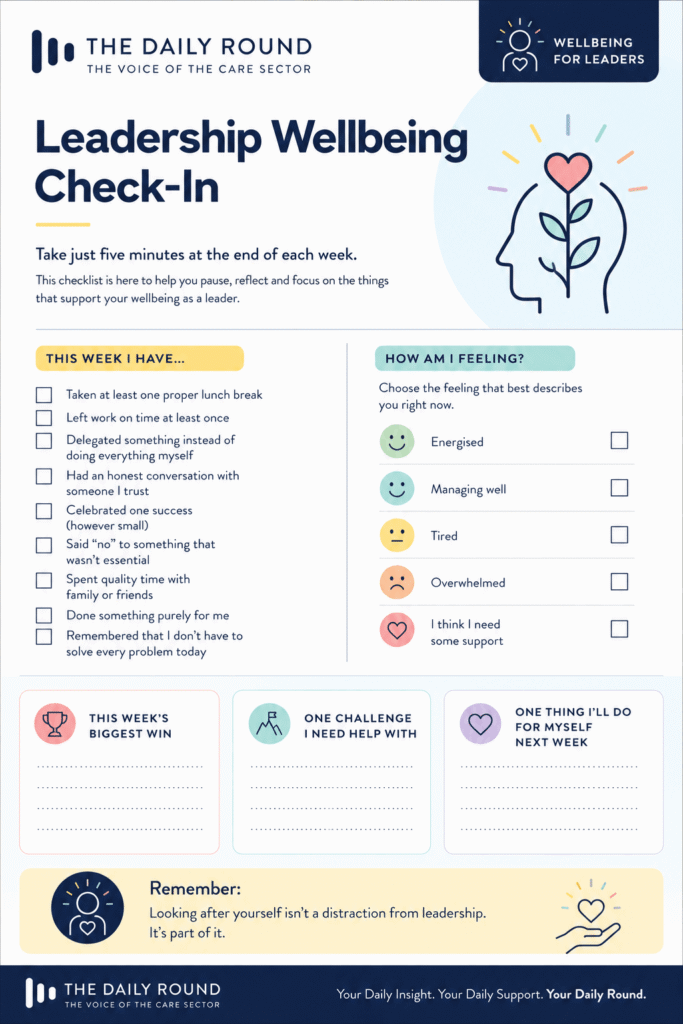
Download our Leadership Wellbeing Check-In template. It’s the start of taking care of you, so you can take care of others.
If you’re beginning to recognise the signs of leadership burnout, knowing where to find support for leaders can be an important first step towards protecting your wellbeing and continuing to lead effectively. For more practical guidance and resources focused on supporting leaders, explore Wellbeing for Leaders.
Posted by:
Mehala
Editorial Assistant – The Daily Round
Busy day? We’ve got you covered. Get FREE daily news, practical insights, opportunities and wellbeing content, carefully curated for busy health and social care professionals. Just enter your details below to get The Daily Briefing delivered straight to your inbox.
 newsdesk@dailyround.news